Why did Wenger change to Bould-ball, and will he stick with it?

Bould and Wenger in harmony?

I’m a fan of Wenger, but over the last 8 years, he has come into a lot of criticism for his unwillingness to change from Plan A; criticisms which not even the most ardent Wenger supporter could fully refute. On the flip side, I do believe he comes under excessive criticism from some sectors over his stubbornness, the reason being his changes are normally subtle; rather than substituting or changing systems, he would rather change players’ roles or moves.

I also pose the question that if Wenger was such a poor tactician – as some fellow Gooners believe – we would not be the best second half team in the premiership this season; as it is in second halves when in-match tactical changes tend to show really well.

Despite my support, the defensive frailties are a tactical issue that Wenger has not really addressed for the vast portion of the season – much to the frustration of our fans, who grew wearisome of watching a Vermaelen cock-up that Mertesacker couldn’t keep up with to stop. Times were looking bleak until finally, at the Allianz Arena in Munich, it appeared that Wenger rectified the mistakes he was making at the back. The first question is why? What caused the change in system that had been plaguing our defence?

First things first, it is clear that in Munich we had nothing to lose. With no Wilshere, our midfield threatened to be overrun; we had lost 3-1 at home and were no longer under the illusion we could win this game stylishly. For once our team had the luxury of going for broke, and Wenger took it with both hands. With a team who had come under a lot of fire for shoddy-defending, Wenger saw the chance to try something new against top class opposition.

Secondly – The Tottenham loss and the missing game against Everton. Mertesacker spoke about how the Tottenham game caused the defence to have a closer look at their issues. I believe the break that was enforced due to Everton’s FA Cup game massively contributed to its effectiveness, as it gave the players a longer time to reflect.

In what was considered our biggest game of the season, two high-profile Vermaelen errors gave us the excuse to drop our captain – giving the now-impressing Koscielny his chance. I know it maybe too early to draw conclusion, but the Bayern game seemed to show me that the more disciplined Koscielny is a far better partner to Mertesacker than the gung-ho Vermaelen.

But what caused us to stick with Bould-ball? Well, quite clearly the performance against Bayern. Now I’m not just talking about the fact that we won, the crucial part of the win was that we scored twice, and could well have had an ONSIDE Walcott 3rd , or narrowly–missed Gervinho 4th. There is no point dwelling on the missed chances, but the point is that when fans watched the game they were thoroughly entertained, watching a defensively focused team that produced a game that in no-way could be labelled as anti-football.

Swansea, a fairly attacking team, then faced us next.This could not have been timed better; a slightly weaker team that like to attack enough to allow us to test out our new system once again. Despite early errors, we showed over the 90 minutes how sturdy our defence can potentially be. In spite of the praise received for the result, there is still reason to worry as questions can be raised as to when the system is effective. The deeper 4-2-3-1 sacrifices something in the attack, and that should be kept in mind when we are facing opposition that will look to lock us out. For example, don’t expect Reading or WBA to attack us like Bayern or Swansea.

My final and main reason I think this system will work, is actually due to the problems we’re having. The play is breaking down in the midfield; watching the silly passes, it seems to me that this is due to the lack of familiarity with the tactical style. It is very clear that our new defensive system requires our midfielders to step up. It is very plausible that in a few weeks we will still retain a serious attacking threat, without sacrificing our defensive strength.

You can view the decision to start dropping deeper as a negative way of playing, but I disagree: with more attacking fluency our team could play a beautiful attacking game, whilst maintaining defensive solidity. Others may disagree, but I believe we have the quality there, and as the crunch time approaches we might just be starting to show it.

Written by: Rohan

Rohan has recently started up his own Arsenal weblog: Ashburton Arsenal. It is a great blog with some fine articles for you to read, and I encourage you to have a look at it and a leave a comment on his site: 

http://ashburton-arsenal.blogspot.co.uk (see also BK’s blogrole).

TotalArsenal.
Beautiful defending and the great sound of ‘2-0 to the Arsenal’

The BFG
The BFG

 It is a legitimate thing to defend…in a legitimate way!

Last week was arguably one of the best we have had this season – first we won an away match against one of the best European teams (if not the best one), and managed to restrict them to no clear-cut chances, and then we won in Wales against Swansea with another brilliant defensive performance in which opponents had no shots on target. It’s not just that we won two away matches against tough opponents that made me especially happy, but also the fact that we managed to reply to our home defeats against those same opponents. And, all that without Jack Wilshere, Bacary Sagna, Thomas Vermaelen and Wojciech Sczszesny in the first eleven, and with Lukasz Fabianski on the goal after more than a year without an appearance.

These two victories could hardly be described as typical Arsenal victories in the Wenger-era. Both opponents had bigger share of possession (both teams had 55 percent), but neither of them managed to transform possession into something more efficient.

These victories could hardly be described as „park-the-bus“-type of defending, given that we had more dangerous attacks and counter-attacks than both Bayern and Swansea. Both victories had brilliant defending based on sound foundations, and I think that is exactly how we should do it until we get ourselves a world-class striker.

Remember, not so long ago, we were defeated by Bayern at home and against North London Chokers away. In both defeats, the most heard comment with reference to the Arsenal games in South-Slavic languages was that Arsenal have „neither head nor tail“, since our performances in front of both goals had been terrible and expensive.

There are some people who seem to confuse terms „quality defending“ and „anti-football“. Restricting opponents’ chances in a legitimate way doesn’t necessarily means that you are an anti-football coach.

If you are a responsible manager, you will do your best to use club resources (including players you have) in the best possible way. You can’t make a banana-split out of a lemon, but you can make a decent lemonade.

Let’s take a look at another last-16 CL match. When AC Milan played Barcelona at San Siro, they completely nullified all Barcelona qualities, and switched Lionel Messi off. Barcelona had all that possession they wanted but in both final thirds of the pitch, it was AC Milan who got what is really important: a clean sheet and two scored goals. When their manager Allegri abandoned his tactics from the first game, and his players like Ambrosini opted not to fight for every ball, the Italian giants were destroyed and Messi scored two out of four Barcelona goals (one of them should have been ruled out due to offside).

There is a similar example from our favourite season 2003-04 when we lost 0:3 against Inter at home only to beat them 5:1 at Meazza. Inter were managed back then by Hector Raul Cuper and he came at London without Christian Vieri but still demonstrated the highest level of quality defending, and got themselves a comfortable victory. We all know what happened in reverse fixture. Cuper was sacked, and Inter appointed Alberto Zaccheroni as their manager. Zaccheroni didn’t follow the path made by Cuper and, despite Vieri’s return to the team, and Arsenal playing without Vieira, Lauren, Keown and Wiltord, Inter managed to lose  not just the game, but also a high aggregate lead against us, which  Cuper had left to Zaccheroni.

One might say (and it could be true) that Arsenal’s success during the Wenger-era was based on George Graham’s defense, and Arsene Wenger’s midfield and attack; before adding that problems only really started when Wenger tried to apply his way of defending which neglected the physical part of the game.

It is a great thing when you can have both fluent attacking football and results; something that we had with Invincibles. But sometimes one of those things has to be sacrificed, and we all know which one any fan would opt for. Our performances during the Champions League campaign in 2006 were hardly breath-taking (especially second leg against Villarreal), but we managed to knock-out Real Madrid, Juventus and Villarreal without conceding a goal in six consecutive games (ten, when we count group phase), and we were unlucky to lose against Barcelona in the Final. Speaking of Barcelona, we were very close to knock them out from the Champions’ League in 2011, despite the fact that we failed to make a single shot on target in second leg.

Now, I mentioned above the terms ‘quality defending’ and ‘anti-football’. If there is a team that represents everything that Wenger’s Arsenal hasn’t been, it’s Stoke City managed by Tony Pulis. Their football has been more like rugby, as it is full of horrible tackles that go unpunished thanks to the lenient policy by Football Association towards the actions of the ‘Butchers from Britannia’. Is it because FA wants to preserve traditional English football? Do they keep Stoke City afloat as some sort of ZOO in which the last examples of traditional English football based on muscles, tackles and challenges can be seen? In the first match we played against Stoke this season, their players made three fouls that deserved red cards. They got none.

But there is this thing called karma for that too. When FAnchester United lost to Real Madrid mostly thanks to the fact Nani got sent off, they couldn’t believe that someone could give a straight red card to their player. When Pierluigi Collina backed referee Cakir, I realized that the biggest problem United had in that game was the fact that they are used to the criteria of another bald referee, who tolerated a life-threatening tackle by Nigel De Jong in World Cup Final in 2010. And that’s how karma works:  Italians put their trust into Pierluigi Collina who gave penalties and red cards against Juventus despite the status Juventus have had among most of Italian referees, and they were rewarded with 4th World Cup title in 2006, where they showed classy defending and being runners-up at Euro 2012; while England – who consider Howard Webb as their best referee – failed to reach any Final since 1966, and will mostly regret the poor taking of penalties and stupid red cards being received by FAnchester United players.

Alas, my point is, ‘quality defending’ and ‘quality football’ are not mutually exclusive terms; just like ‘beautiful football’ doesn’t necessarily means ‘quality football’. Being called ‘one-nil-to-Arsenal’ again wouldn’t be the worst thing that could happen to us.

After all, if we continue with performances like the previous two fixtures, we might even earn a new nickname: ‘two-nil-to-Arsenal’!

Written by: Admir.

Why are Arsenal 2nd half performances so much better? A theory.

player-scrum

This is a question I am sure many of you have asked yourself recently. Most will have heard this statistic by now: if only second half performances would count in the PL, Arsenal would be top of the league! Incredible stuff!

Why is it that we start not just sluggishly in midfield and attack, but also so poorly defensively this season? Especially against the top teams we have handed the game to them through bad defensive mistakes in the early stage of the first half, time and time again.

Yet, come the second half and we are usually firing from all cylinders. The team seems to be transformed after the half time breaks: starting with real purpose and shape to our football, and fully determined to win the game at all cost. Why cannot we play with the same intensity and focus from the start? Is there something wrong with our preparations? Do our players need a rollocking at half time to make them play better; or is it more to do with tactical adjustments?

I have been thinking about this situation for quite a while and I will share some of my thoughts with you in this post. But please join in with your arguments as well, as together we might get a bit closer to the truth regarding this bizarre situation.

Paradoxically, the fact that we do so much better in the second halves of our games compared to the first ones, is both disturbing and filling us with hope. If we could only spread out our form for the entire 90 minutes of the game, our performances would increase significantly.

But why aren’t we?

I reckon Arsene and Steve do little in terms of specific tactical preparation with the team prior to a match, as in analysing an opponent’s weaknesses and strengths and determining a bespoke strategy on how to beat them. I don’t know this for sure, but going with Fabregas’ comments regarding this subject a while ago, I reckon there must be some truth in it.

Arsene is a strong believer in playing our own game/ style of football and this should overcome everything that is put in front of us. He is not alone in this: any manager who believes in a ‘total football’ approach tends to focus their energy on perfecting the system rather than adjusting it every time, depending on whom we play against. Johan Cruijff, Louis van Gaal, Guardiola, Jurgen Klopp, etc do/did it to a large extent. If the system is made perfect and maintained in that way, it will deliver the very best there is: highly attractive and very successful football.

However, it is not easy to get to a level where the team can conquer all: it takes a lot of time and effort. And it really does not help that our best players – including our two previous captains – have left us in mini-droves over the last few seasons.

I reckon, Arsene is struggling at the moment to get the team to play once more his football philosophy and tactical concept to the required levels. I really do not think our players lack the motivation when they start a game, but somehow it is not clicking between the players, and as a result, they simply underperform collectively.

At half time, Wenger and Bould can talk to the players about specifics that are not being done the way they should be done in a particular game. As a result, the players come out with a clear picture of how to be more effective and with more collective belief that they can turn things round. The turnaround in performances, from the first half to the second half, have been significant this season.

I reckon the longer the team plays together the better they will understand, and be able to execute, Arsene’s system of football and associated tactical principles. Hopefully, the team will start playing as well in the first halves as they do in the second halves, as soon as possible. It would make a big difference to the remainder of our season.

But how do you explain our underperformances in the first half, and what should Arsenal do differently?

Written by: Total Arsenal.

How Arsenal should beat Bayern: tactics & ideal line-up

Bastian+Schweinsteiger+6fL8btJ1cpsm

For those of you who don’t know this yet: Bayern Munich have spent every single day of the season at the top of the Bundesliga table. They currently have a record of 17 wins, 3 draws and 1 defeat; with 55 goals for and 7 against. They kept 19 clean sheets in 30 games in all competitions, and only once did they have less possession than their opponent (1-0 victory at Lille).

This season is certainly Bayern’s best in a very long time and it could become the best Bundesliga campaign ever.

So why are Bayern that good?

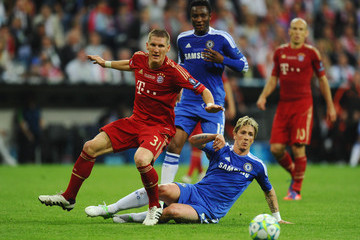
Key to their game is the last statistic I mentioned – possession. The man who runs the show in the middle of the park is Bastian Schweisteiger. In my opinion he  has established himself as Bayern’s most important player over the last couple of years. Despite earning a lot of criticism after missing the penalty against Chelsea, and playing a very bad Euro 2012, he got back to full fitness and form in this season. He is an exceptional passer of the ball and directs the play  to the wide areas most of the time. He also has a very good shot, and is never shy of joining the attack and appearing in the opponent’s box himself. He is simply perfect at running the show.

He also enjoys a good partnership with Toni Kroos, who plays directly in front of him. The young German has a very free role. He is a very good striker of the ball and will look for cut-backs or little one-twos and through balls, to set up chances for himself and the players around him. Both Schweinsteiger and Kroos move around a lot and they seem to be everywhere.

The most important aspect of Bayern’s style going forward is their wing-play. With Robben, Ribery, Müller and Shaqiri they have 4 wingers who have everything a winger needs: pace, trickery (Müller a little less), good crossing, good shooting from distance, and they all like to get into the box to score themselves.

Another key to their wing-play are their full-backs: David Alaba and Philipp Lahm. These two go on the attack whenever Bayern go forward and try to link-up with the winger ahead of them. They either create the space the winger needs or get a good cross, pass or shot away.

The man lurking for all those crosses and through-balls is their centre-forward. Mario Gomez played this role in the last two season scoring 80 goals in 97 games. This season Gomez’ faced a long injury break, and Bayern reacted before the season by bringing in Mario Mandzukic, who scored 16 in 24 games this season. Both of them score most of their goals from inside the box which is the final part of Bayern’s wing-play. These are two of the most prolific goal scorers from inside the box, and seem to be able to score out of every position with every part of their body.

All this going forward is only possible with a decent protection at the back. At this time last season Bayern had already conceded 14 goals and lost 5 games in the Bundesliga. The biggest change regarding this aspect has been the arrival of Javi Martinez. The Spaniard sits in front of the two CB’s and provides all the cover that Schweinsteiger and the full-backs need in order to go forward. On top of that he is very good on the ball himself and also has the ability to create chances with good build-up play from the middle of the park.

How to beat them

I think there are two teams we can learn a lesson from: Borussia Dortmund, who have beaten Bayern five times in a row before their draw in this Bundesliga season; and Chelsea, who of course won the Champions League Final against the German giants. Key to the successes over Bayern for both of them was their disciplined defending.

Their wingers had to work back more than they worked forward. They always doubled-up with their fullbacks to keep Bayern’s normally so effective wing-play to a minimum. This also left the opportunity to run counter attacks and this is exactly how we can hurt Bayern as well.

Our ideal line-up for the Bayern match:

170213231640

I think that Arsenal should start against Bayern with  a 4-2-3-1 formation because I cannot see us winning with only one holding midfielder. So I would slot Wilshere in next to Arteta, to stop Kroos and Schweinsteiger from operating through the middle, but also to double-up on the wings. In addition, Wilshere will be able to apply a lot of pressure on Schweinsteiger as soon as he gets the ball. Especially at the Euros, he made a lot of mistakes when he wasn’t given any time on the ball and that might be a factor we could capitalize on. Wilshere will be able to win a lot of balls in this position and play or run the ball forward.

The most likely way for us to win this match is on the break, which is why Theo should play up front. His pace and goal scoring form will be exactly what we need. I want to see Ox on the right because of his commitment towards defense. He will track back against David Alaba a lot more than Theo would and with his pace he will be a great support to Theo on the break. Podolski has shown time and time again for Germany how reliable he is on the left wing, when it comes to defending duties. He should also play, because he knows really well how most of his opponents play.

Podolski and Santi are not the quickest players, but should be great support on the break. Santi should also play attacking midfielder to direct the play, when we manage to get stuck in Bayern’s half. He seems to always find the right pass to put Theo, or Ox, or Pod into scoring position, and is very deadly himself, of course.

I would love to keep Mertesacker out of the starting line-up because of the pace of Ribery, Müller, Robben and Shaqiri (last two could feature as subs), but now that the Verminator has to play left-back there is no other option than to play him. With Mandzukic, Martinez, Dante and Boateng Bayern have 4 real targets for set pieces, but I think with Mertesacker, Vermaelen and Koscielny we have good cover.
Yes I haven’t mentioned our in-form striker Olivier Giroud yet. I think he is at his best in games where we control the game and can put a lot of balls into the box, but I just can’t see that happen.

Santi Cazorla celebrates after scoring against Reading

I believe that Bayern will control the game and our main priority – even at home – should be counter attacking. Just like we did against Barcelona two season ago.

With the above formation and tactics we could beat Bayern, but I am really interested in hearing your views on whether, and how, we can beat them on Tuesday as well.

Come on You Gunners!

Finally, I want to thank the host of this blog for giving me the chance to express my opinion on our Champions League tie with Bayern Munich.

Written by: Nik (A Gooner based in Germany).