
Call me a romantic fool as much as you like, but football should never be totally ruled by money. It saddens me that clubs like Everton, Villa, Newcastle United, West Ham, Leeds, Sheffield Wednesday and many, many more will probably not win the title in the next twenty to thirty years; they have not got a snowball’s chance in hell, unless they find an oligarch or other rich benefactor.
It makes me think of Leonard Cohen’s song ‘Everybody Knows’:
Everybody knows that the dice are loaded
Everybody rolls with their fingers crossed
Everybody knows that the war is over
Everybody knows the good guys lost
Everybody knows the fight was fixed
The poor stay poor, the rich get rich
That’s how it goes
Everybody knows
Everybody knows that the boat is leaking
Everybody knows that the captain lied
Everybody got this broken feeling
Like their father or their dog just died
You could argue, as a Gooner, I should not be too upset about this at all. We are in a very good position, financially as well as from a sporting point of view, as a next round of CL-participation is once again within our reach. The stadium debt is under control and the club generates the fourth highest turnover in Europe: all ingredients are there to compete sensibly and yet effectively with the old fellow giants, MU and Liverpool, as well as the oil-funded nouveau riche, in the foreseeable future.
But I would much rather prefer proper competition, and as per Red Arse’s recent fantastic posts, there is little reason to be hopeful that FFP will increase the chances of other English clubs winning the EPL or CL in future.
It does indeed feel that the war is over and the good guys have lost. Unless, another English/Welsh club can find itself a very rich, money-no-object, benefactor, or the Oilers get bored with their plaything, the top-four over the next ten to twenty years will almost constantly be occupied by Arsenal, Chelsea, MU and MC.
But even within the top-four there is a battle raging and it is all to do with the meaning of money. And Arsenal run a considerable risk of coming close, but seldom or never be able to put their well deserving hands on meaningful silverware, whilst still remaining in the elite group of four (or maybe five, if Liverpool can work themselves back up again).
A similar battle is taking place in other European countries.
In Spain the war is definitely over as Barcelona and Real Madrid have managed to get the lion-share of all the TV money that is generated by La Liga, and these two clubs will simply continue to cream off any talents that might develop at all the other Spanish clubs. It looked for a while that Malaga, funded by oil-money, might be able to join them in the fight for Spanish silverware, but that ship seems to have sailed now as well.
In Germany, the competition appears to be fairer with five different Bundesliga winners over the last ten years, even though Bayern Munich are the most powerful club, both historically and financially. But this might all change now, as only Bayern seem to be able to keep hold of their top players, whilst all other German clubs watch their top talents being creamed off by the Spanish, Italian and English top-clubs or, even worse for local competition, by FC Hollywood themselves. The purchase of Gotze (and possibly Lewandowski) by Bayern from Dortmund is clear evidence of this. Although, it is fair to say that Dortmund do the same to their domestic rivals to some extent as well.
And let’s not talk about the Italian competition: a total shambles in recent years.
Nous versus the power of money: Ajax vs PSV Eindhoven
I grew up in The Netherlands were the competition was mainly dominated for a long time by just two clubs: Ajax and PSV, with Feyenoord now and again winning a title as well. The former was, and still is, almost always looking to play a form of total football and build teams predominantly on the best ‘outputs’ of their youth development scheme, whilst the Philips sponsored and, until recently, generally richer ‘Eindhovenaren’ preferred to buy the best from the Dutch league and whoever they could afford and attract from abroad.
Although I have never supported either Ajax or PSV – Roda JC is my boyhood club – I always felt more affinity with the Ajax model of managing a club and wanting to be successful. It has led to better, more attractive football, more success/silverware, and also more respect across the world. Ajax played some of the best football ever seen and produced an incredible number of phenomenally good footballers over the decades. And nothing is more attractive and laudable than beautiful winning football.
And I believe, it’s me growing up with both models of football which has made me divide most, if not all, successful football in either the Ajax-model: total football, home-grown players, and based around sensible club management; or the PSV-model: classic football – either more attack focussed or defence focussed – mainly externally purchased players, and based around financial power/dominance within the local league.
With the arrival of oligarchs in the UK and across Europe, the ‘PSV-model’ has become more dominant recently. Chelsea and ManCity have forced themselves into the top four and onto silverware by buying the best players and paying through the nose for them, and the same is happening now in France and Russia. And I am sure more is to come.
Add to those, the might of the traditionally rich and powerful, and ‘PSV-alike’, clubs: Manchester United in the UK, Bayern in Germany, and Real Madrid in Spain, and you can see that the clubs who are less rich but try to win things with football nous and bottom-up development of talents are suffering at the moment.
There is a growing unease, especially here in the UK, that the ‘Ajax-modelled’ clubs are fighting a losing battle, and that the only way to compete is by (out) spending big: fighting fire with fire. For that we would need our existing two main shareholders to dig deep into their considerable pockets or get somebody else in who is prepared to bring in the big guns and knock the arrogant Mancs of their throne.
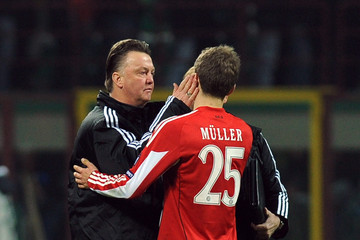
I personally hope it will not come to that, and there is good reason to remain optimistic. Just like Van Gaal did with Ajax in the nineties, and to some extent Arsene did with Arsenal in the last decade, Jurgen Klopp is showing us all again that with real football nous, the (financial) Giants – old or new – can still be beaten. And this should give hope to Arsenal, and the likes of Swansea and Liverpool who are going down a similar path as us.
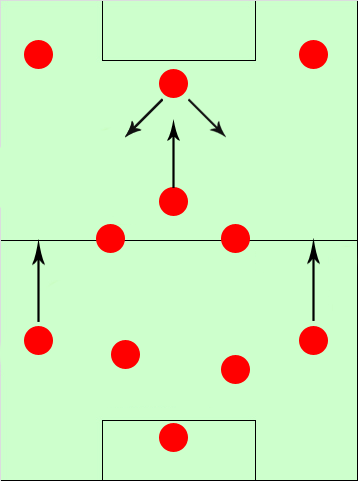
The key principle here is to play a form of total football that can conquer all, and in which individual players become less important than the system of football and the team as a whole. Everybody knows their role(s) within the team and can be replaced without much or any loss in quality. The system of (total) football is so good that the whole of the team becomes a lot more than the sum of all individual players.
Van Gaal mastered this principle as no other in the mid-nineties, when his Ajax won the CL with a team of youngsters and good but definitely not established, great players (except for veteran Rijkaard). This was the team that beat start-studded Milan twice on the way to CL glory in ‘95: Van de Sar, Reiziger, Blind, Rijkaard, F. de Boer, Seedorf, George, Davids, R. de Boer, Litmanen and Overmars. Overmars and Davids were 22, and Seedorf and Kluivert (who came on as a substitute and scored the only goal of the final) were both under 20. Van Gaal almost did it again the year after but Ajax lost against Juventus in the CL final on penalties (the nemesis of Dutch football).
We all know how Arsene slowly but steadily build and bought together the Invincilbes, and how he has been investing a lot in developing his teams bottom-upwards, through focussing on young and promising players and developing them into top players, over the last eight years or so. He showed the rest of the UK, and to some extent Europe, that you do not need to buy established top quality players in order to compete. However, he was not able to hold on to his best home-grown players in recent years, and this has cost us dearly. And the desperation for Silverware is increasing rapidly year on year…
And then finally, there is Dortmund who under Klopp’s expert guidance are playing a new and exciting brand of total football and who, until now, appear to be immune to losing a quality player every season. For Klopp, individual players are not above the club or the system of his football, and if a player really wants to leave, he can do so. Klopp seems to find like-for-like, or sometimes even better, replacements with relative ease. Two Bundesliga titles in three year, one cup (and one double), and now in the final of the CL after beaten the Galacticos in style: some achievement!
And we can draw hope from Die Schwarzgelben recent successes.
Now that we appear to be over the financial restraints of building the new football ground, Arsene, although in a more challenging domestic set-up than Klopp in terms of competition, should be able to hold on better to his players and start adding quality rather than having to find replacements with a limited budget.
Let’s hold on a bit longer and keep the Oligarchs away from our fine club: the home of football. The good guys have not lost, yet!
Written by: TotalArsenal.



 Bergkampesque