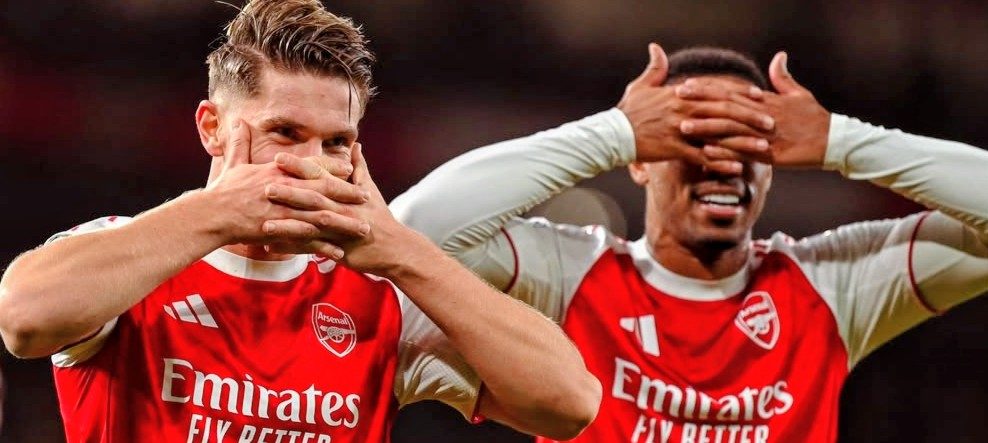
Slavia Prague: the next opponent on our road to the 2nd EL final in 3 years
Arsenal’s bid to reach a second UEFA Europa League final in three seasons continues against a Slavia Praha side who have already eliminated two other British clubs on their way to the quarter-finals. Czech opponents are rare to come by in the later stage of European competitions, but this is far from the first time to visit Prague. In fact, we have played against clubs from the Czech Republic – all in the beautiful capital city of Prague – but mostly (6 games) against their local rival Sparta Praha. We met Slavia Prague once already (literally 2 games in the Champions League in 2007/2008) and we have nice memories from the first game… but let’s not go there so quickly. This post is not primarily about Arsenal, but our next EL opponent, Slavia.
Club history
Slavia is one of the most renowned and successful clubs in the history of the Czech Republic. It is located in Prague, and has been playing in the Czech top tier. They are a big-time sports club there as they have decorated teams in hockey, basketball and rugby as well under the same name: Slavia Prague.
Their closest rival and arch nemesis is AC Sparta Praha – the most successful club in the local history – but they were crowned Czech champions last time in 2010, while Slavia came up first 3 times in the last 4 years. So the supporters of our current opponent believe that the trend is about to turn maybe in this very decade.
While Sparta Praha was named in the fond memory of the bravery and fighting spirit of the ancient Greek polis Sparta, Slavia Prague focused the recollection to the people inhabiting the region from 1500 years (Slavs have been populating almost entire Central-Estern Europe – apart from Hungary – for a long time: from Ukraine to Slovenia, from Poland to Bulgaria, from Slovakia to Russia, from Macedonia to the Czech Republic). The club was named SK Slavia Praha in 1893 – 1 year after its founding – and been called different versions of this name except for the 1949-1965 period.

The club’s colours, red and white, were chosen as standing for the heart/blood and sportsmanship (fair play) respectively. Therefore the team plays its home games in a red and white jersey – another red & white team after Benfica and Olympiacos, and hopefully one more in the Gdansk final: Ajax. There is a tilted red star in the logo as well, it represents the traditions and history of club and country as well as new hope, forever strengthening the mind and uplifting the spirit.
Stadium and legends
Slavia plays its home games in their own stadium called Eden Aréna which was renovated between 2006 and 2008. While the supporters still informally refer to the place as Eden (the reference to the garden of eden is applicable in the Czech language too) the stadium has undergone a few name changes in the last decade, eventually called to Sinobo Stadium when CITIC Group, a Chinese – state owned (!) – real estate company saved the club from bankruptcy and became majority shareholders.

The stadium was refurbished for 1B koronas (~€30M) 15 years ago, therefore it is the biggest and most modern stadium in the Czech Republic. It has a capacity of 19.370 seats, and besides Slavia Prague occasionally acts as home venue for the Czech national team (In the 2011-2012 season FC Viktoria Plzen played their home games in the Champions League group stage).
The highest profile game played here was the UEFA Super Cup final in August, 2013 when CL winner Bayern Munich beat EL holder Chelsea on penalties (after 1:1 and 2:2 a.e.t). The Czech national team defeated England for the 2020/2021 UEFA Euro qualifying in October, 2019 – Kane’s 5th min penalty was responded by Brabec (9’) and Ondrášek (85’).
When thinking about the player who scored the most goals of their life people usually guess Romario, Puskás or C. Ronaldo, but that might not be accurate. Legendary Josef “Pepi” Bican was born in Vienna in 1913 and became one of the best football players of 20th century. He played for Slavia between 1937 and 1948 and after his spell in Vítkovice returned to red and white in 1953 for four more years. He scored 447 league goals. He is probably the football’s leading goalscorer of all time. It is said he scored close to 1,500 goals in total during his days, other sources claim above 1800 (yet he still is 2nd when all unofficial goals are accounted). http://www.rsssf.com/players/prolific.html
Another player worth mentioning is Pavel Kuka, icon of 1. FC Kaiserslautern and Slavia Prague. He was also a key player of the Czech national team winning a silver medal at the 1996 European Championship and coming third at the Confederation Cup a year after. He may have not reached such stardom as Bican or Poborsky (played a single year for Slavia), but his name Kuka – which incidentally is the Hungarian name of Dopey, the 7th dwarf – made him an instant favorite among Hungarian football lovers.
For fellow bloggers more knowledgeable in English football, Patrik Berger could be the notable mention as the cheeky attacking midfielder – between starting (4y) and ending (2y) his career at Slavia Prague – was German champion and cup winner with Borussia Dortmund, but is better known for his contributions (including his trademark long range rockets) to Liverpool’s domestic and European success when he was playing his trade there between 1996 and 2003. https://www.youtube.com/watch?v=s3zxic_esVo
Football results
Slavia Prague are 13-times Czechoslovakian champions, and won the Czech competition (after the 2 countries have split in 1993) 6 times already, including last year. They won the cup 9 times (4+5).
In Europe Slavia was runner up in the summer of 1930 when Swiss champion Servette organized a major tournament of top European clubs from Spain, Italy, Netherlands, etc. that is considered the ancestor of the European Champions’ Cup (forefather of UEFA’s Champions League). It is unofficial though since 4 countries (Belgium, France, Romania and Yugoslavia) didn’t take part as they participated in the World Cup in Uruguay. The tournament was won by Hungarian club Újpest who scored 14 and conceded only 1 in the entire tournament. Slavia Prague won the Mitropa Cup – a Central-European mini Champions League in 1938 ahead of runner-up Ferencváros. This tournament was officially called the La Coupe de l’Europe Centrale, the first recurring major European football cup and was held between 1927 and 1992. Slavia was runner-up in 1929.
In the mainstream European football the biggest success of Slavia was reaching the semi-final of the UEFA Europa League in 1996 (losing against future runner-up Bourdeaux), and they reached the quarter final 3 times: in 2000 they lost against Leeds, in 2019 they lost to future winner Chelsea and they are facing a huge challenge against us currently. J
In the Champions League Slavia Prague qualified to the group stage twice in their history. In the 2007-2008 season they came third – behind Arsenal and Sevilla – thus continued in the Europa League, and last year they were drawn in a hardcore group against FC Barcelona, Borussia Dortmund and Inter Milan, where they were eliminated (ended up last with 2 points), but their away draws at Barcelona and Milan are quite respectable performances.
This season Slavia started in the CL, but lost the play-off round against Danish champion Midtjylland. They were drawn to group C with Bayer Leverkusen, Hapoel Be’er Sheva and Nice (without Saliba) where they qualified for the knock-out stage by finishing 2nd in the group. They won all 3 home games and the away fixture in France.

In the first elimination round they met Leicester City whom they defeated in the second leg in the King Power Stadium after a 0:0 draw in Prague. Rangers had a similar fate, with the small adjustment of the 1:1 draw in the first leg, but they were also eliminated after a 0:2 home defeat. So basically after a strong home start in the group stage Slavia managed to overcome 2 strong UK teams by winning the 2nd leg away from home. The other notable difference is that they conceded 10 goals in the 6 games of the group phase, but only 1 in the 4 knock-out matches.
Slavia and Arsenal
Arsenal have played eight games against Czech opponents in Europe, winning seven, losing none, scoring 22 goals and conceding just two. The biggest win came against our current opponent Slavia in October, 2007, when Wenger’s men won by 7:0 thanks to braces from Fabregas, Hleb and Walcott (concluding a Bendtner wrap-up goal). Arsenal started the game in 4-4-2 with Almunia in goal, a Sagna-Toure-Gallas-Clichy defense, Eboue, Fabregas, Flamini and Hleb in midfield and Adebayor paired with Walcott in attack. https://www.youtube.com/watch?v=WhGq8lWqK-g Slavia general manager Stanislav Vlček played for the club in the 7-0 defeat at the Emirates.
The game in Prague ended 0:0, but our memories are rightfully fond. Yet we must respect the opponent. Not only for general sportsmanship reasons, but they have good footballers, even though star players (outgoing record transfer €20M) Tomáš Souček and Vladimír Coufal both joined Arsenal’s London rivals West Ham United from Slavia in 2020.
While Arsenal stands 10th in the PL with the form LDLWWD, Slavia Prague sits on top of the Czech championship with an excellent form of DWWWDW. Our opponent is a compact team with quality players (mostly on the wings and flanks), and they are full of confidence based on the domestic run and the impressive EL history this season, but they have limited experience in playing against teams of Arsenal’s caliber. Currently, both teams prioritize the Europa League; Arsenal because it’s the only way to play in Europe next season (and in the Champions League!), and Slavia because they have a massive 14 points advantage ahead of city rival Sparta Praha, having played only 2 games more. Even if Sparta wins both games in hand the remaining 8-point advantage should be more than comfortable with 9 matches remaining from the season.
Failing to score in their last game (vs Olympiakos), Arsenal ended an impressive record of scoring in 25 consecutive European matches. Hopefully we’ll get back to finding the net on Thursday.
Current players and predicted line-up
Not only Arsenal is injury-ridden, but Slavia Prague lost its star goalkeeper Ondrej Kolar 2 weeks ago (sinus fracture), as well as experienced (and gigantic) center back Simon Deli to coronavirus. Nevertheless they are strong on the wings, 19-year-old Abdallah Sima (already playing for the national team of Senegal) and Nigerian Peter Olayinka will put pressure on our full-backs. Their midfield is also quite capable, but due to injuries and inexperience I expect our boys to score a few goals as 20-year-old David Zima would be the most senior player in the Czech central defence (out of 5 CBs 3 are injured and 1 is ineligible in the EL).
Nevertheless their attacking 4-5 is quite dangerous (age, primary position and season goal contributions in brackets): Jan Kuctha (24, ST, 22), Abdallah Sima (19, LW, 25), €4M incoming record transfer Nicolae Stanciu (27, AM, 19), Lukas Provod (24, LW, 14) and Peter Olayinka (25, RW, 16) are not to be taken lightly.
I predict Slavia starting in 4-1-4-1 formation, with a possible line-up:
–––––––––––Kuchta–––––––––––
Olayinka–Stanciu–Provod––Sima–
––––––––––Hromada––––––––––
Boril©–––Zima–––Holes––––Bah–
–––––––––––Vagner–––––––––––
TA will provide the predicted Arsenal line-up below, but let me sign off with an interesting fact – and a possibility to screw one of our London rivals:
A maximum of five PL teams are eligible for the Champions League. If a Premier League club (Liverpool) wins the Champions League while another (Arsenal) wins the Europa League and neither finish in top 4 in the PL, the club lying fourth in the table (Chelsea/Spurs) will drop into Europa League.
Yours truly:
PB
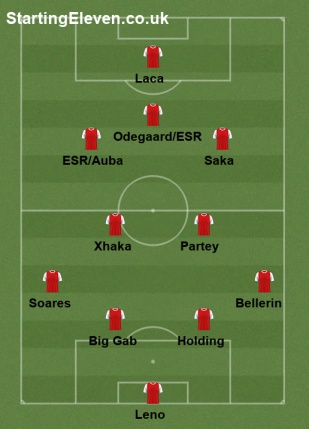
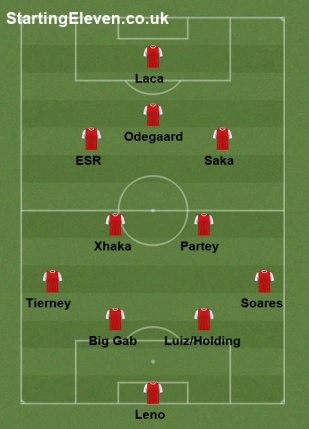
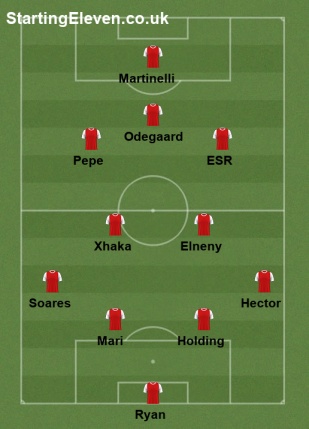
Predicted Lineup (depending on fitness) by TA:



 Bergkampesque

