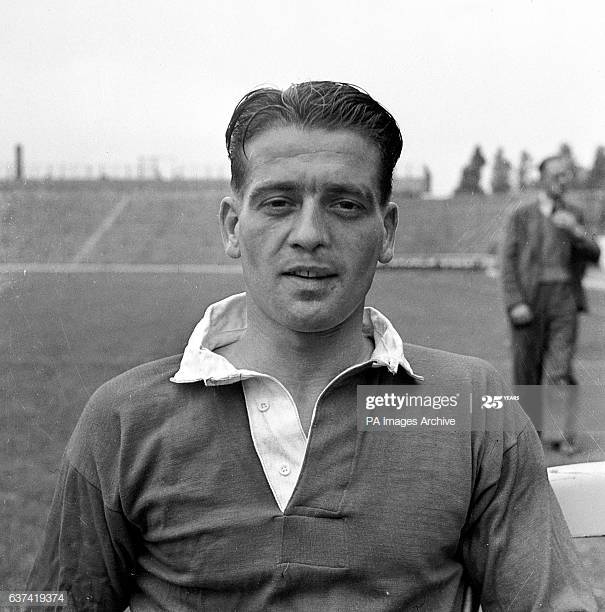
Born in Birmingham, Doug first played as a centre forward for non-league Paget Rangers, before signing as a professional for Third Division South Walsall in August 1946. In two seasons with the Saddlers, Lishman scored 26 goals in 59 league appearances.
He was signed by Arsenal in the summer of 1948 for £10,500, as backup for Reg Lewis, who was only 28 but was injured frequently, Doug made his debut against Sheffield United on September 4, 1948, but a promising first season (scoring 13 goals in 25 appearances), and his 1949-50 and 1950-51 seasons were marred by injuries. He was passed over for the 1950 FA Cup final (which Arsenal won 2-0), in favour of Lewis and Peter Goring, and then just as he came back into the Arsenal first team, he broke his leg playing against Stoke City on Christmas Day in December 1950.
However, he recovered to become Arsenal’s top scorer in 1950-51, and the next season hit 30 goals, including three hat-tricks in three successive home matches;
(GN5 saw them all)
27 October 1951 4-3 v Fulham
10 November 1951 6-3 v WBA
24 November 1951 4-2 v Bolton W
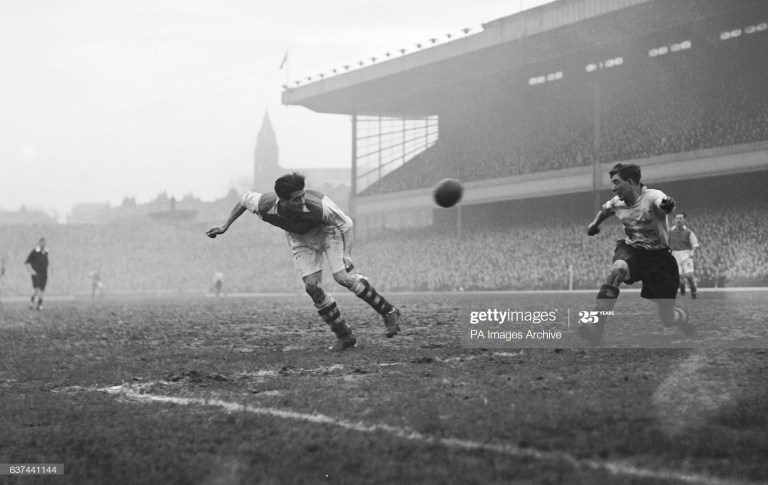
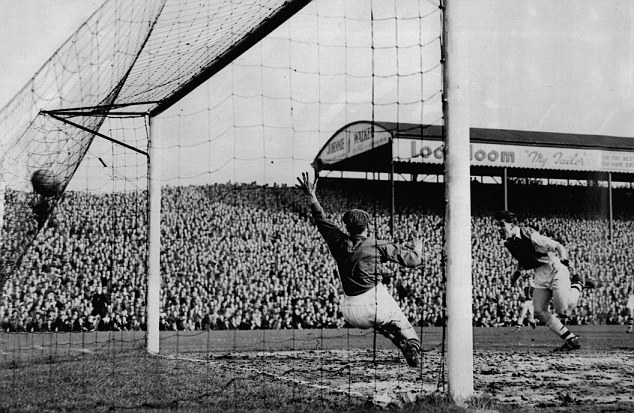
Arsenal finished third that season. The following season (1951-52) they reached the FA Cup final, only to lose to Newcastle United; a series of injuries meant only eight fit players finished the match (no substitutes were allowed in those days). Doug came close for Arsenal with a header, which clipped the crossbar, but Arsenal lost 1-0.
His disappointment was soon forgotten, as Arsenal won the League Championship in 1952-53. He was again Arsenal’s top scorer, this time with 26, and with every goal proving vital, Arsenal won the title on goal average above Preston North End. His form was good enough for him to be picked for an England B match against Scotland B in March 1953, although he was never capped for the full national side.
Doug was top scorer for another two seasons after that, making it five successive seasons as the club’s top scorer in total. He scored 137 goals in 244 appearances, making him the club’s tenth-highest goal scorer of all time. However with younger men like Derek Tapscott and David Herd taking over goal scoring duties for Arsenal, Doug was dropped from the first team in 1955-56.
In March 1956 he was sold to Second Division Nottingham Forest. He scored a hat-trick in the match that got Forest promoted (a 4-0 win over Sheffield United) to Division One in 1956-57, but decided to retire in the summer of 1957. He left the game entirely after retiring. He joined his father-in law in business (furniture retail) in Stoke on Trent, later taking over the business himself. He continued to live in Stoke on Trent until his death in 1994.
Doug scored his 100th goal for Arsenal against Cardiff City at Ninian Park on September 26th 1953.
David Herd was born on 15 April 1934 in Hamilton, Lanarkshire, his mother went north to family just prior to his birth so he could qualify for Scotland like his father.
His father helped Manchester City win the FA cup a few weeks after David’s birth; David grew up in Moss Side beginning his professional career at Stockport County as an amateur in 1950. He signed professionally a year later and in May 1951 played as a 17 year old in the same Stockport forward line up as his 39 year old father Alec. David scored in the 2-0 win.
Herd caught the eye of Matt Busby in 1952 but a hiccup scuppered the transfer deal and he remained at Edgeley Park in the 3rd Division North. National Service intervened and for two years he was in the RAF, and a few hours after his demobilization Tom Whittaker swooped to purchase him on 24 August 1954 for £10,000.
Herd made his Arsenal debut on 19 February 1955 at home to Leicester and took a while to bed into the team, but between 1957-1961 he was the leading Arsenal goal scorer for four successive seasons. One of these goals was scored for the Gunners in the Busby Babes’ last match on English soil, a 4-5 defeat at Highbury on 1 February 1958, often noted as one of the greatest ever games.
For Arsenal Herd scored 107 goals in 180 appearances. At one point an explosive right foot missile of his was timed at 72.5 mph, it being no surprise he was nicknamed “Hot Shot” Herd. He is the club’s 16th highest ever goal scorer, with a hit ratio of 0.594 goals per game, which places him just outside the all time top ten of Arsenal’s best strike rates. He also played 85 games in the reserves and scored 46 goals, one of which was in the 1954-55 final of the London FA Challenge Cup in which Arsenal beat West Ham.
His final match for the club came on 29 April 1961 at Everton, where he scored in a 1-4 defeat. Despite all his goals the best League position while at the club was third in 1958-59, and it would have been understandable were he to look elsewhere for the chance of honours. This course of action appeared to be encouraged as manager George Swindin offered him as a makeweight in deals for both Denis Law and George Eastham in March and September 1960. More than hinting he was not part of the manager’s longer term plans, it was somewhat ironic as Herd ended up the 2nd highest scorer in the whole of the top flight during the 1960-61 season.
Consequently, Herd moved to Manchester United on 26th July 1961 for £40,000. There he won 2 League and 1 FA cup winners medals, and he also received a European Cup winners medal as a squad member. A broken leg in 1967 put paid to his position in their forward pecking order. He is 13th in Manchester United’s all-time goal scoring list, 145 goals from 265 appearances, which was almost identical to his scoring ratio while at Arsenal.
On 15 July 1968 he moved to Stoke City on a free transfer, and then onto Waterford briefly in 1970 before ending his playing career which had seen him net 272 times in 516 appearances!
A Scotland international, he scored 3 times in the 5 occasions he appeared for his country between 1958-61. All of these caps were won at Arsenal which aside from being a ridiculously low total for such a natural goal scorer, is an indictment of the SFA in repeatedly ignoring a title winning forward.
A short spell as manager of Lincoln City in the early 1970s saw the his football career come to a halt and he ran a number of Manchester based car garages before retiring in 1999. He also enjoyed playing golf and cricket.
David Herd passed away on 1 October 2016.
Former Arsenal, Manchester United and Scotland centre forward David Herd passed away on October 1st, 2016, after a five-year battle against vascular d.
He joined the Gunners in what is now known as “The Dark Era”. The team which had won the FA Cup in 1950 and the League in 1953 was breaking up and during Herd’s seven years in North London, the Gunners never finished better than third. That was in 1958-59, the season in which Herd won the first of his five Scottish caps, when he was one of four debutantes named for the opening Home International of the season, against Wales, in Cardiff.
He left football to enter the motor trade in the Manchester area, running a garage in Urmston right up until he reached retirement age in 1999.
He had first invested in the business in 1965, already looking ahead to the end of his playing career. It gave him ample opportunity to indulge in his love of fast cars, while his sporting instincts were satisfied by his long-time membership of Ashton-on-Mersey Golf Club – where he had a low handicap for many years, and by playing cricket for various club sides around his home in South Manchester.
A “destructive” batsman, he was still playing first-team cricket into his 60s, while, away from the sports field, he enjoyed cruising holidays, visited Malta at least once each year and made two trips back to Scotland each year, to see family and to attend the Dunhill Links Championship at St Andrew’s, which he loved.
David scored his 100th goal for Arsenal on January 1st 1961 at Highbury, it was the third goal in his third hat trick of the season.
Born in Heavitree near Exeter, Cliff started his career at Exeter City, making his début for the club in 1928, at the age of 16. Despite only playing 17 games and scoring 6 goals in his time at Exeter, he was spotted by Arsenal manager Herbert Chapman in a match against Watford; Chapman was attending to keep tabs on a Watford player, but the 17-year-old Bastin’s ability was so evident that Chapman decided to sign him at the end of the 1928-29 season.
He made his début against Everton on 5 October 1929 and was immediately a first team regular, making 21 appearances that season. He went on to become an integral player in the side over the next decade, playing over 35 matches for every season up to and including 1937-38. His play was characterised by a remarkable coolness, and deadly precision in front of goal; he also became Arsenal’s regular penalty taker. Cliff’s scoring feats are all the more remarkable considering he played on the left wing rather than as centre forward; at the time Arsenal’s strategy depended heavily on their wingers cutting into the penalty box, and the supply of passes from Alex James was the source of many of his goals.
Cliff won the FA Cup twice, in 1929-30 and 1935-36, and the First Division title five times, in 1930-31, 1932-33, 1933-34, 1934-35 and 1937-38 and by the age of nineteen he had won a League title, FA Cup and been capped for England, making him the youngest player ever to do all three. Cliff also finished as Arsenal top scorer twice (1932–33 and 1933–34, though after centre-forward Ted Drake arrived in March 1934, Cliff was no longer Arsenal’s number one target man. With Drake scoring the lion’s share of the goals and Alex James increasingly unavailable due to injury and age, Cliff was moved to inside-forward to replace James for much of the 1935-36 season but he still scored 17 goals, including six in Arsenal’s run to the 1936 FA Cup Final, which they won 1-0. After a stint at right half to cover for Jack Crayston, he was eventually restored to the left wing and scored 17 goals in the 1937-38 title-winning season.
Cliff was a key part of the side that dominated English football in the 1930s. He scored 178 goals in 396 games, which made him Arsenal’s all-time top goal scorer from 1939 until 1997, when his total was surpassed by Ian Wright. In 2005 Thierry Henry passed both Bastin and Wright’s totals, thus meaning Bastin is currently Arsenal’s third-top goal scorer of all time. His record of 150 league goals for Arsenal stood for slightly longer, until it was equalled by Thierry Henry on 14 January 2006 and surpassed on 1 February.
During his career Cliff also played for England between 1931 and 1938, winning 21 caps and scoring 12 goals. Cliff played in the notorious friendly against Germany in May 1938 when the players gave the Nazi salute in the pre-game ceremonies. England won 6-3 against a side that had a 16 game winning streak – Cliff scored the first goal.
Less controversially, Bastin appeared in the film “The Arsenal Stadium Mystery” in 1939. The last game at Highbury, before the outbreak of the Second War against Brentford was used for filming the shots of the game in the film. The war intervened when he was only 27. He was excused war service for failing the army hearing test, and served as an ARP Warden at the Highbury Stadium. His film appearance in 1939 was not his last – in 1942, Cliff Bastin played a footballer in the classic British war film “One of our aircraft is missing”. He continued to play football in the war-time league that was instituted for raising civilian morale. Bizarrely, Mussolini’s Fascist Italian Radio claimed in 1941 that he had been captured in the Battle for Crete. He didn’t play football again until after the war, when he played 6 times, to retire in January 1947, having suffered with an injury to his right leg in the 1938/9 season.
Cliff scored his 100th goal for Arsenal on October 28th, 1933 against Aston Villa in an away game at Villa Park.
Arsenal’s Century Club
#
Player
Years
Games
**
Goals
GPG
10
Cliff Bastin
1929-46
396
174
178
0.45
11
Thierry Henry
1999-07
377
181
226
0.60
12
Olivier Giroud
2012-18
253
237
105
0.42
13
RVP
2004-12
278
238
132
0.47
14
Alan Smith
1987-95
347
251
115
0.33
15
Frank Stapleton
1972-81
300
276
108
0.36
16
Denis Bergkamp
1995-06
423
296
120
0.28
17
John Radford
1962-76
481
306
149
0.31
18
Joe Hulme
1926-38
374
307
125
0.33
19
Theo Walcott
2005-18
397
370
108
0.27
** Games played to reach 100 goals.
After retirement, Cliff returned to his native Exeter and became landlord of The Three Tuns at Silverton, and then ran the Horse & Groom public house in Heavitree, Exeter. A stand at St James Park, Exeter’s home ground, is named in his honour and in 2009 he was inducted into the English Football Hall of Fame.
He died in 1991 at the age of 79.
As a kid I was familiar with the name Cliff Bastin as my family often spoke about him at their “discussions” after each game. I had his picture in my scrap book, (cut out of newspapers) but unfortunately he retired after the 1946/47 season, one season before I started to go to games.
Thierry appeared in 377 games over a 13 year period and scored 226 goals.
Thierry was born and raised in Les Ulis suburb of Paris which, despite sometimes being seen as a tough neighbourhood, provided good football facilities. As a seven-year-old, he showed great potential, and was recruited by the local club CO Les Ulis. He joined US Palaiseau in 1989, but after a year his father fell out with the club, so Henry moved to ES Viry-Châtillon and played there for two years.
In 1990, Monaco sent scout Arnold Catalano to watch Thierry, when he was just 13 years old, he scored all six goals in a 6–0 win. Catalano asked him to join Monaco without even having a trial first, later he joined Arsène Wenger’s Monaco as a youth player. Subsequently, he signed professional forms and made his professional debut in August 1994. Although Wenger suspected that Thierry should be deployed as a striker, he put him on the left wing because he believed that his pace, natural ball control and skill would be more effective against full-backs than centre-backs.
He was named the French Young Footballer of the Year in 1996, and in the 1996–97 season when Monaco won the Ligue 1 title. By his third season, he had received his first cap for the national team, and was part of the winning team in the 1998 FIFA World Cup. He continued to impress during his tenure with Monaco, and in his five seasons he scored 20 league goals in 105 appearances.
Thierry left Monaco in January 1999 and moved to Italian Serie A club Juventus for £10.5 million. He played on the wing, but found it difficult playing in an unfamiliar position against the Serie A defensive discipline, and scored just three goals in 16 appearances. Unsettled in Italy, he transferred from Juventus in August 1999 to Arsenal for an estimated fee of £11 million, reuniting with his former manager Arsène Wenger. It was at Arsenal that he made his name as a world-class footballer. Brought in as a replacement for fellow French forward Nicolas Anelka, Thierry was immediately moulded into a striker by Wenger, a move that would pay rich dividends in years to come. However, doubts were raised about his ability to adapt to the quick and physical English game when he failed to score in his first eight games.
After several difficult months in England he conceded that he had to “be re-taught everything about the art of striking”. These doubts were dispelled when he ended his first season at Arsenal with an impressive goal tally of 26. Arsenal finished second in the league behind Manchester United, and lost in the UEFA Cup Final against Turkish side Galatasaray. Despite recording fewer goals and assists than his first season, his second season with Arsenal proved to be a breakthrough, as he became the club’s top goal scorer. Armed with one of the league’s best attacks, Arsenal closed in quickly on perennial rivals Manchester United for the league title.
Success finally arrived during the 2001–02 season. Arsenal finished seven points above Liverpool to win the league title, and defeated Chelsea 2–0 in the FA Cup Final. Thierry became the league’s top goal-scorer and netted 32 goals in all competitions as he led Arsenal to a double and his first silverware with the club. 2002–03 proved to be another productive season for him, as he scored 32 goals in all competitions while contributing 23 assists, remarkable returns for a striker. In doing so, he led Arsenal to another FA Cup triumph, where he was man-of-the-match in the Final. Even though Arsenal failed to retain their Premier League crown, he was named both the PFA Players’ Player of the Year and FWA Footballer of the Year. His rising status as one of the world’s best footballers was affirmed when he emerged runner-up for the 2003 FIFA World Player of the Year award.
In the 2003–04 season Thierry was again instrumental in Arsenal’s exceptionally successful campaign; together with team mates the likes of Dennis Bergkamp, Patrick Vieira and Robert Pirès, he ensured that the Gunners became the first team in more than a century to go through the entire domestic league season unbeaten, claiming the league title in the process. He was named as the PFA Players’ Player of the Year and FWA Footballer of the Year, for the second year running. With 39 goals scored in all competitions, he led the league in goals scored and won the European Golden Boot.
In the 2004–05 season he maintained his reputation as one of Europe’s most feared strikers as he led the league in scoring, and with 31 goals in all competitions, he was the co-recipient (with Diego Forlán) of the European Golden Boot. In mid-2005 Thierry became the Arsenal Captain.
The 2005–06 season proved to be one of remarkable personal achievements for Thierry on 17 October 2005, he became the club’s top goal-scorer of all time; two goals against Sparta Prague in the Champions League meant he broke Ian Wright’s record of 185 goals. On 1 February 2006, he scored a goal against West Ham United, bringing his league goal tally up to 151, breaking Arsenal legend Cliff Bastin’s league goals record. He completed the season as the league’s top goal-scorer, and for the third time in his career, he was voted the FWA Footballer of the Year.
In a surprise move Arsenal sold Thierry to Barcelona on 25 June 2007, for €24 million.
Henry left Arsenal as the club’s leading all-time league goal-scorer with 174 goals and leading all-time goal-scorer in Europe with 42 goals; in July 2008, Arsenal fans voted him as Arsenal’s greatest player ever in Arsenal.com’s Gunners’ Greatest 50 Players poll. Following his time with Barcelona, he signed a four-year deal for a reported €6.8 (£4.6) million per season, with the Red Bulls of the MLS.
After training with Arsenal during the MLS off-season, Thierry re-signed for the club on a two-month loan deal on 6 January 2012. This was to provide cover for players participating in the 2012 Africa Cup of Nations. He made his second Arsenal debut as a substitute against Leeds United in the FA Cup third round and scored the only goal. In his last league game on loan, he scored the winning goal in stoppage time in a 2–1 win against Sunderland.
Awards and honours:
Monaco:
Ligue 1 (1): 1996–97
Trophée des champions (1): 1997
Arsenal:
Premier League titles: 2001–02, 2003–04
FA Cup: 2002, 2003, 2005
FA Community Shield: 2002, 2004
Barcelona:
La Liga: 2008–09, 2009–10
Copa del Rey: 2008–09
Supercopa de España: 2009
UEFA Champions League: 2008–09
UEFA Super Cup: 2009
FIFA Club World Cup: 2009
New York Red Bulls:
MLS Eastern Conference: 2010
National:
1998 FIFA World Cup
UEFA Euro 2000
FIFA Confederations Cup2003
Individual:
UNFP Ligue 1 Young Player of the Year (1): 1996–97
PFA Players’ Player of the Year (2): 2002–03, 2003–04
PFA Team of the Year (6): 2000–01, 2001–02, 2002–03, 2003–04, 2004–05, 2005–06
FWA Footballer of the Year (3): 2002–03, 2003–04, 2005–06
Premier League Golden Boot (4): 2001–02, 2003–04, 2004–05, 2005–06.
Golden Boot Landmark Award 10 (1): 2004–05
Golden Boot Landmark Award 20 (1): 2004–05
Premier League Player of the Month (4): April 2000, September 2002, January 2004, April 2004
Goal of the Season (1): 2002–03
UEFA Team of the Year (5): 2001, 2002, 2003, 2004, 2006
MLS Best XI (2): 2011, 2012
MLS Player of the Month (1): March 2012
Onze d’Or (2): 2003, 2006
European Golden Boot (2): 2003–04, 2004–05
French Player of the Year (5): 2000, 2003, 2004, 2005, 2006
IFFHS World’s Top Goal Scorer of the Year (1): 2003
FIFA FIF Pro World XI (1): 2006
FIFA World Cup All-Star Team (1): Germany 2006
FIFA Confederations Cup Golden Ball (1): France 2003
FIFA Confederations Cup Golden Shoe (1): France 2003
UEFA European Football Championship Team of the Tournament (1): 2000
FIFA 100: 2004
English Football Hall of Fame: 2008
A statue of Thierry stands outside the Emirates Stadium as a tribute to one of Arsenal’s greatest players
Arsenal’s Century Club
#
Player
Years
Games
**
Goals
GPG
11
Thierry Henry
1999-07
377
181
226
0.60
12
Olivier Giroud
2012-18
253
237
105
0.42
13
RVP
2004-12
278
238
132
0.47
14
Alan Smith
1987-95
347
251
115
0.33
15
Frank Stapleton
1972-81
300
276
108
0.36
16
Denis Bergkamp
1995-06
423
296
120
0.28
17
John Radford
1962-76
481
306
149
0.31
18
Joe Hulme
1926-38
374
307
125
0.33
19
Theo Walcott
2005-18
397
370
108
0.27
** Games played to reach 100 goals.
Thierry scored his 100th goal for Arsenal against West Ham at Highbury on January 19th, 2003.
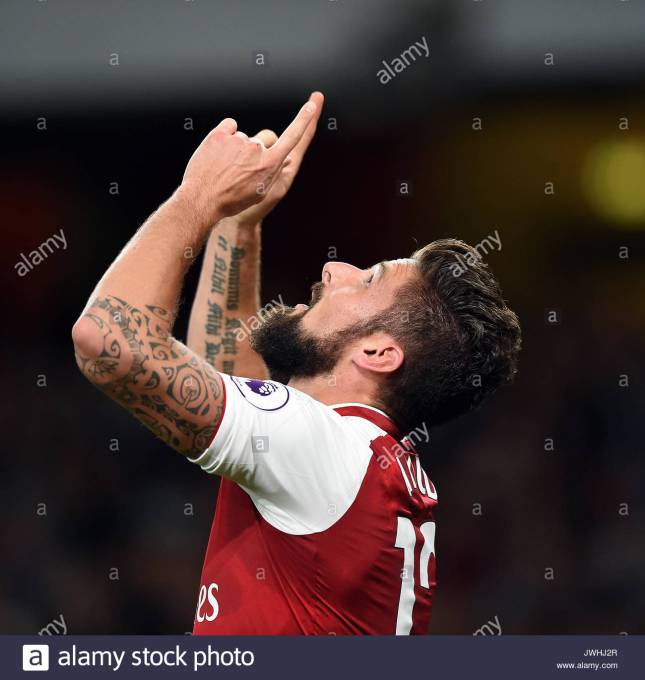
Oliver Jonathan Giroud was born in Chambery, France on September 30th 1986.
He began his career at Grenoble in Ligue 2 before joining Tours in 2008. He was the league’s highest scorer with 21 goals in his second season at Tours. On July 1st 2010 he joined top-flight side Montpellier and scored 21 goals in the 2011–12 season, helping Montpellier to their first ever Ligue 1 title.
Giroud made his full international debut for France in 2011. He has earned 87 caps, and was part of the teams which reached the quarter-finals at UEFA Euro 2012 and the 2014 FIFA World Cup, the final of UEFA Euro 2016 in which he received the Bronze Boot as joint second-highest goal scorer, and won the 2018 FIFA World Cup.
On 26 June 2012, Arsenal signed Giroud on a long-term contract for a fee of around £9.6 million and was given the number 12 shirt. He made his debut on 18 August as a substitute in a goalless home draw against Sunderland in the Premier League and scored his first Arsenal goal on 26 September, in a 6–1 win against Coventry City in the League Cup. He scored his first goal in Europe in the UEFA Champions League in a 2–2 draw at Schalke.
On 22 August, 2014 he broke his left tibia and was ruled out for four months but returned to action quicker than expected, replacing Aaron Ramsey for the last 13 minutes of a 1–2 home defeat against Manchester United on 22 November and scoring Arsenal’s consolation goal in added time.
On 30 May, 2015 he scored Arsenal’s fourth goal after appearing as a substitute in the team’s 4–0 FA Cup Final victory over Aston Villa at Wembley Stadium.
On 1 January 2017, he scored his iconic and unforgettable back heeled “scorpion kick” volley in a 2–0 win against Crystal Palace, a goal described by Arsène Wenger as the greatest he had seen at the Emirates Stadium. The goal later earned him the FIFA Puskás Award for the goal of the year.
During the 2017 FA Cup Final against Chelsea at Wembley, Giroud came on in the 78th minute with the score 1–1, and a minute later he delivered an assist for Aaron Ramsey to score the winning goal which saw Arsenal lift the Cup for a record-breaking thirteenth time.
On 28 September 2017 during Arsenal’s Europa League group game away to BATE Borisov, Giroud scored his 100th goal for the club in a 4–2 victory.
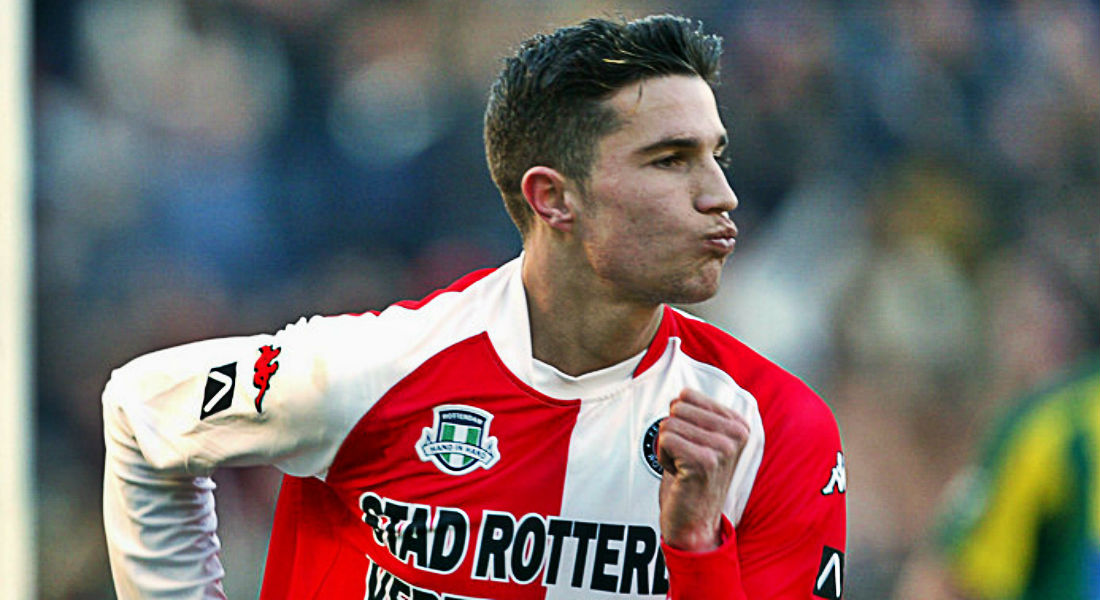
Robin vanPersiewas born in Rotterdam, Netherlands. The son of two artists, he was encouraged to follow in his parents’ footsteps, but he preferred football.
He joined Dutch side SBV Excelsior’s youth squad at the age of 14 years, but left at the age of 15 and signed for Feyenoord. He was quickly promoted into the first team due to injury problems among the squad, and made his debut for the club at 17, which was the first of 15 total starts. He received the KNVB Best Young Talent award at the end of the 2001–02 season and then signed a professional three-and-a-half-year contract the following season. Clashes with his manager Bert van Marwijk saw him demoted to the reserve squad, he finished his tumultuous debut season on the first team, making a total of 28 appearances and scoring eight goals, in addition to finishing runner-up in the KNVB Cup. Feyenoord unsuccessfully attempted to extend his contract during the off-season. His deteriorating relationship with van Marwijk led to his spending most of the 2003–04 season on the bench. He again played 28 matches, but finished with two fewer goals than the previous season.
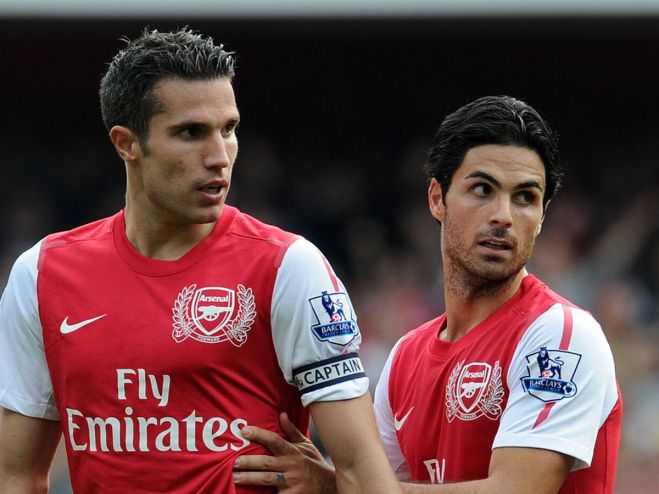
On 17 May 2004, Robin signed a four-year deal with Arsenal for £2.75 million, just over half of Feyenoord’s original asking price of £5 million. Arsenal manager Arsène Wenger, who planned to convert him from a left winger to a centre forward, said of his new acquisition, “He can play on the left side of midfield, as a creative player behind the main strikers or as a target man. Robin spent most of his time on the bench during earlier parts of the 2004–05 season, and made his competitive debut on 27 October by scoring Arsenal’s opening goal in a 2–1 League Cup win over Manchester City. He was sent off for the first time, in an Arsenal shirt, on 26 February against Southampton, following a lunge at left back Graeme Le Saux, for which Wenger was seen yelling an obscenity at him from the sidelines. He then later lambasted him in the press stating “I do not support Van Persie today” Telegraph sportswriter Clive White described Van Persie in his match report as “21 going on nine.” He was consequently benched for a number of games, starting with Arsenal’s FA Cup replay against Sheffield United, and he was reintroduced into the squad only after Henry was out with a calf injury, his return to the first team saw him score twice in a FA Cup semi-final win over Blackburn Rovers. The rest of his season was cut short by injury, and he finished with ten goals in 41 appearances in all competitions.
Robin’s good form at the start of the 2005–06 season earned him the Player of the Month award for November 2005 after eight goals in eight starts, and he was rewarded with a five-year contract extension until 2011. Two days after signing the contract, however, he was once again hit by injury when an opponent stepped on his foot and broke his toe during an FA Cup match.
The beginning of the 2006–07 season included an airborne volley against Charlton Athletic that Arsene called “the goal of a lifetime” and he was later named BBC Sport’s Goal of the Month for September, and he capped off the calendar year by being named the 2006 Rotterdam Sportsman of the Year. His season, however, ended early for the second time in his career on 21 January, when he fractured the fifth metatarsal in his right foot. After the departure of Thierry Henry he assumed the role as Arsenal’s main striker. Following a streak of seven goals in ten regular-season games, he was sidelined for two months with a knee injury suffered on international duty. He made his comeback in Arsenal’s Champions League group stage on 12 December and made his Premier League return in the win against Chelsea over the weekend. However, he picked up a recurrent injury that kept him sidelined until January when he played 45 minutes in a League Cup game against Tottenham Hotspur. He was withdrawn at half-time following another injury scare and featured sporadically throughout the rest of the campaign. The following season (2008–09) he was named as the Arsenal.com Player of the Season. With only one year remaining of his contract, it was announced in July that he had signed a new long-term contract with his club, stating, “My heart is with Arsenal and I just can’t picture myself in a different shirt.”
On 14 November 2009, he injured his ankle in an international friendly and was initially expected to be out for six weeks, but further tests showed that he would be out for five months. Before the start of the 2010–11 season, his squad number was changed to number 10. He made his 200th appearance in August but an ankle injury suffered in the game placed him on the sidelines once again. He returned as a substitute for Arsenal’s
0–1 defeat to Newcastle United on 7 November. On 1 January 2011, he scored his first goal of the season in a 3–0 away win over Birmingham City. On 15 January, he added two more goals to his tally in a comfortable 3–0 win over West Ham. This made him only the fourth Dutchman to reach 50 goals in England’s top division. Robin scored his first career hat-trick in a 3–0 win over Wigan Athletic on 22 January and two goals against Newcastle United in a 4–4 draw on 5 February. Continuing his fine form, he hit a brace the following week against Wolverhampton Wanderers scoring both Arsenal goals in a 2–0 win including a volley from inside the box. The ten goals he scored between 1 January and 12 February set a new Premier League record for most goals scored in the first two months of a calendar year.
He set the Emirates alight with a goal from an almost impossible angle in Arsenal’s fight back against Barcelona in the UEFA Champions League Round of 16 which ended 2–1 in favour of the Gunners. On 27 February 2011, Van Persie captained Arsenal at Wembley Stadium in the League Cup final, scoring the first half equalizer for the Gunners. It was his first goal at Wembley and his first in a cup final for Arsenal. However, he was later taken off in the second half with a knee injury he picked up while scoring the goal. He was voted as the second best player of the 2010–11 season on Arsenal’s official website and also received the team’s Goal of the Season award for his audacious strike in the 2–1 victory over Barcelona in the Champions League.
Having been appointed vice-captain for the 2010–11 season, he was promoted to club captain at the start of the 2011–12 season. He finished the season as the top goal-scorer in the Premier League with 30 goals, and became Arsenal’s 8th all-time top scorer with 132 goals.
On 4 July 2012, he announced that he would not be signing a new contract with Arsenal.
Finally after a series of rumours he was transferred to Manchester United for a reported £22.5 million. Supporters of Manchester United voted Van Persie as the Sir Matt Busby Player of the Year for the 2012–13 season.
His 100th goal was his 2nd of the game in a 2-0 win against Sunderland on Oct 16th, 2011 at Highbury.
There I was, in lockdown, doing my utmost to be productive and to make some good use of the time I have to spend indoors by having the old clear out, it’s always good for the soul to have a clear out, you know out with the old making room for the new.
Anyway as I sorted through some old papers, mostly from the last century, I found an old Arsenal reserve programme, although programme isn’t really accurate as it was a single sheet, but it was a record of the game and it showed that Arsenal Reserves vs Chelsea Reserves played at Highbury in the Avon Insurance Combination, Saturday (yes Saturday!) 10th September 1994, kick off: 3pm (yes 3pm!). How quaint I thought.
It must have been an entertaining game as I wrote the score down as 3-3, but obviously after over 25 years I have no recollection of the game, how the scoring went or how either team played tactically, although you can hazard a guess by the line ups.
Did Arsenal play with a back four or a back three as that was in vogue at the time in England? Oh yes a back three, very continental…
The Chelsea team was a mixture of youngsters, old timers and the odd big signing probably trying to regain some fitness after injury or form after being dropped. That’s what I liked about the Comb’ it allowed experienced players to play with, guide and impart their knowledge onto the youngsters, all the training sessions in the world can’t replicate that.
The Chelsea line up was Kevin Mitchell in goal, then Terry Shiverton, Scott Minto (a biggish signing from Charlton) Craig Norman, Michael Duberry, Andy Dow, David Hopkin, Robert Fleck (a big signing from Glasgow Rangers), Zeke Rowe, Mussie Izzet and Darren Barnard. On the bench was Paul Hughes and Graham Rix!
For Arsenal, our line up was Lee Harper in goal, then Matthew Rose, Gavin McGowan, Paul Davis (changed before kick off to Adrian Clarke), Graeme Hill, Stephen Morrow, Jimmy Carter, Paul Shaw, Paul Dickov, Paul Read, and Stephen Hughes – our subs were Mark Flatts and Chris McDonald, Flatts replacing Clarke during the game.
I didn’t record who scored for Chelsea but Paul Read scored one goal for us and Paul Dickov got a brace. For some obscure reason I seem to recall an Arsenal come back, so it’s possible we were losing.
I’m sure that you all know what happened to many of those 26 players, so I’ll leave it for your good selves to comment on, but for Arsenal Reserves at the time the star man to me was Stephen Hughes, we all predicted big things for him, I also liked McGowan, Read and Shaw, but none of them made it at Arsenal.
The Arsenal Reserve Coach at the time was none other than the legend that was George Armstrong and in the previous season the Arsenal Youths coached by Pat Rice had won the FA Youth Cup, beating Millwall 5-3 in a two – legged final. McGowan, Hall, McDonald, Rose and Hughes were all involved.
Just to put some context as to where Arsenal were at the time, the previous season an injury hit Arsenal team coached by George Graham had beaten Parma 1-0 in Copenhagen to lift the European Cup Winners Cup; it was probably one of George Graham’s finest achievements in beating an exciting Parma team with a midfield of Paul Davis, Ian Selley and Stephen Morrow.
Graham became only the second and last Arsenal manager to win a European trophy for the club and was gone before 1994/95 season was concluded.
Alan Martin Smith: born 21 November 1962 in Hollywood, Worcestershire.
A striker, Smith started his career at non-league Alvechurch in north Worcestershire. He then signed professional forms with Leicester City in June 1982. In his first season, he scored 13 goals in a partnership with Gary Lineker, as the Foxes won promotion to the First Division. He spent five seasons at Leicester, scoring 84 goals in 217 appearances. He was transferred to Arsenal in March 1987, but then loaned back to Leicester for the rest of the season.
His first league goal for the club came on 29 August 1987, when he netted a hat-trick in a 6–0 game versus Portsmouth at Highbury. Smith scored the first goal in Arsenal’s 2-0 victory at Anfield in May 1989 which saw them lift that season’s league championship. With Arsenal he then won another league title in 1991 as well as a League and FA Cup Double two years later. He also struck the sole goal in Arsenal’s 1994 European Cup Winners’ Cup Final victory against Parma. Smith was Arsenal’s top scorer for four consecutive seasons, and the First Division top scorer of the 1988–89 season with 23 goals. He also went on to win another Golden Boot in 1991.
He received just one yellow card throughout his entire career.
Whilst at and away from Highbury, Smith scored a sum of 115 goals for Arsenal. All in all Smith has been ranked at 27th within the club’s listing of the 50 greatest Gunners of all time.
Honours
Arsenal
First Division: 1988–89, 1990–91
FA Cup: 1992–93
League Cup: 1992–93
UEFA Cup Winners Cup: 1993–94
First Division Golden Boot: 1988–89, 1990–91
Alan waited until he was 55 before publishing Heads Up, an honest reflection on his life and career in football and, subsequently, journalism.
Intriguingly for Arsenal fans, this approach leads to a revelation about Smith’s “uncomfortable” relationship with star striker Ian Wright, whose arrival at Highbury coincided with a decline in his fellow-centre-forward’s form.
“My relationship with Ian Wright that was something that I’ve never really spoken to Ian about, but to get it down the page it was quite cathartic,” he says.
“I certainly wasn’t enjoying the football at the time. Wrighty came in, and he did more than anybody thought he would do, he became the club’s top goal scorer and he’s rightfully a legend. In life sometimes things don’t happen like you’d thought they would. I thought we’d make a great partnership, and we didn’t really.
“I have had a chat with Ian [about the book] and he appreciated it. He didn’t say too much. He was very good about it.”
Smith’s book includes reflections on Arsenal’s 1990-91 title win, in which he finished the division’s top scorer with 22 goals. Despite losing only one game fewer, that Gunners team has enjoyed nothing like the reverence afforded Arsene Wenger’s unbeaten class of 2003-04.
He scored his 100th goal for Arsenal against Coventry City at Highbury on July 11th 1992.
Francis Anthony “Frank” Stapleton was born 10 July 1956 in Dublin.
Frank was a tough tackling forward who was an especially good header of the ball. He started his career with Arsenal, joining them in 1972 as an apprentice, after being turned down by Manchester United. He made his first-team debut in 1975 against Stoke City, and went on to form a potent striking partnership with Malcolm Macdonald; the two scored 46 goals between them in 1976–77. He was Arsenal’s top scorer for the three following seasons, and helped the Gunners reach a trio of FA Cup finals; Stapleton scored one of the goals in Arsenal’s 1979 FA Cup Final 3–2 win over Manchester United, and scored 108 goals in 300 appearances in total for the Gunners.
Stapleton went on to move to Manchester United in 1981 for £900,000 (a fee set by tribunal after the two clubs could not agree). He helped United win the 1983 and 1985 FA Cups. It was in the first of those finals, when he scored against Brighton, in which Stapleton made history by becoming the first man to score for two different clubs in FA Cup Finals. He left United in 1987, after scoring 78 goals for the club in 365 matches.
He went on to play for Ajax Amsterdam, before returning to England with Derby County, Blackburn Rovers, Aldershot, Huddersfield Town (as player-coach) and Bradford City, where he spent three seasons after a brief period at Le Havre in France. After being sacked as Bradford’s player-manager in 1994, he had a brief spell at Brighton & Hove Albion in the 1994–95 season, playing two games before finally announcing his retirement as a player.
In 1996 Frank moved to the United States to manage Major League Soccer side New England Revolution.
His team was one of only two which did not reach the play offs in Major League Soccer’s inaugural season; he endured a season long battle with the club’s star player and a running feud with some of its more vocal supporters. In the end, however, it was what he perceived as a “vicious” media campaign and the effect it was having on his family that led Frank Stapleton to tender his resignation as coach of the New England Revolution in the last week of the season.
“I just don’t need any more pressure put on my family,” said Stapleton. “I’m trained to deal with this stuff, but just because you’re married to a footballer doesn’t mean she (wife Chris) can cope with it. Your kids and your family are not immune. I tried to keep them away from it as much as possible, but.” In a 17 year professional career at Arsenal, Manchester United, and Ajax, he thought he had endured the best the English tabloid press could dish out, but, he said on a personal level, this was even worse. “I don’t expect not to be criticised, but this became an ongoing situation. It was as if there was a rivalry between the Boston papers to see who could be the most vicious.”
His 100 goal was scored on December 6th, 1980 against Wolverhampton at Highbury.
Dennis Nicolaas Maria Bergkamp – Born: May 10, 1969 Amsterdam, Netherlands was the fourth of four sons. He was brought up in a working-class suburb; his father who was an electrician played amateur footballer in the lower leagues. He was named in honour of Scottish striker Denis Law but in order to comply with Dutch given name customs, an extra “n” was inserted into his first name, by his father, after it was not accepted by the registrar.
He was spotted by Ajax and was brought up through their famous youth system, joining the club at age 11 and making his professional debut on 14 December 1986. He scored his first senior goal for the club against HFC Haarlem on 22 February 1987 in a match Ajax won 6–0. He went on to make 23 appearances in the 1986–87 season, including a European debut against Malmö FF in the 1986–87 European Cup Winners’ Cup, Ajax won the competition, beating Lokomotive Leipzig 1–0.
In later seasons he established himself as a first-team player for Ajax. This culminated in a period of success for the club that won the Eredivisie title in the 1989–90 season for the first time in five years. Dennis scored 29 goals in 36 games the following season and became the joint top goal scorer in the league. Ajax won the 1992 UEFA Cup Final, beating Torino through the away goals ruling. He was the top scorer in the Eredivisie from 1991 to 1993, and was voted Dutch Footballer of the Year in 1992 and 1993. In total, he scored 122 goals in 239 games for his hometown club.
Dennis attracted the attention of several European clubs as a result of his performances for Ajax. He was insistent on playing in Italy. as he considered Serie A “the biggest league at the time” and preferred a move to either Juventus or Internazionale; on 16 February 1993, he agreed a £7.1 million move to Internazionale and made his debut against Reggiana on 29 August 1993.
In his first two seasons at Internazionale, the club changed managers twice and Dennis had a difficult time, troubled with stress injuries and fatigue from the 1994 World Cup, he only scored five goals in 26 appearances. Off the field, his relationship with the Italian press and fans became uncomfortable. His shy persona and his propensity to go home after matches were interpreted as apathy. Because of his poor performance on the pitch, one Italian publication renamed their award given to the worst performance of the week, L’asino della settimana (Donkey of the Week) to Bergkamp della settimana.
Dennis left Internazionale and signed with Arsenal in June 1995 for a transfer fee estimated at £7.5 million. He became manager Bruce Rioch’s first signing at Arsenal and broke the club’s transfer fee record of £2.5 million. On the opening day of the 1995–96 league season, he made his full debut against Middlesbrough. He struggled to adapt to the English game and failed to score in the club’s next six league matches, prompting ridicule by the national press, he ended his first season with 33 appearances and a goal tally of 11.
The appointment of Arsène Wenger as Arsenal manager in September 1996 marked a turning point in his career. Wenger, who had moderate success coaching in France and Japan, recognised his talent and wanted to use him as a fulcrum of the team’s forward play. Both were advocates of a continental style of attacking football, and Dennis was happy with Arsene’s decision to impose a strict fitness and health regime. Despite making fewer appearances in the 1996–97 season, he was more influential in the first team, creating 13 assists.
The following season he was instrumental in helping Arsenal complete a domestic league and cup double. He became the club’s top scorer with 22 goals and recorded a strike rate of 0.57. In 1997/8 he was the recipient of the PFA Players’ Player of the Year award, becoming only the second foreign player to be recognised by his fellow professionals as the outstanding performer in English football.
After 3 seasons of finishing second more success finally came in the 2001–02 season. Arsenal regained the league, beating Manchester United at Old Trafford in the penultimate game of the season to complete the club’s second double under Wenger; Arsenal defeated Chelsea 2–0 to win the FA Cup four days prior. Dennis played in 33 league matches, setting up 15 goals. After a 3 game red card suspension he made his return against Newcastle United on 3 March 2002. Early in the match, Arsenal midfielder Robert Pirès played a low pass from the left flank to Dennis in the edge of the opponent area with his back to goal. Under pressure from his marker Nikos Dabizas, he controlled the ball with one flick and went around the other side before placing the ball precisely into the bottom right-hand corner to score. Arsene described the goal as “unbelievable”, adding “It was not only a magnificent goal but a very important one – I enjoyed it a lot”
Dennis reached a personal landmark during the 2002–03 season, scoring his 100th goal for Arsenal against Oxford United in a FA Cup third-round tie. On 20 July 2003, he signed a one-year extension at the club. The 2003–04 season ended on a high point as Arsenal reclaimed the league title, becoming the first English team in more than a century to go through the entire domestic league season unbeaten Champions League over two legs. He committed himself to Arsenal at the end of the season, signing a further extension to his contract.
The team finished fourth in the league in his final season at Arsenal. After much campaigning from Arsenal supporters, the club designated one of its Highbury match day themes, organised to commemorate the stadium’s final season as home of Arsenal, to Dennis Bergkamp. “Bergkamp Day” took place on 15 April 2006 It celebrated his contribution to Arsenal; fans were given commemorative orange ‘DB10’ T-shirts – the colour of his national team, his initials and his squad number. Dennis came on as a second-half substitute and set up the winning Pirès goal moments after Nigel Quashie had levelled the score. Fittingly, his 89th-minute goal proved to be his last for Arsenal in competitive football.
He was the focus of the first match at Arsenal’s new ground, the Emirates Stadium. On 22 July 2006, a testimonial was played in his honour at the new stadium as Arsenal played his old club Ajax.
Dennis made his international debut for the Netherlands national team against Italy on 26 September 1990. He was selected for Euro 1992, where his national team were the defending champions. Although he impressed, scoring three goals in the tournament, the team lost on penalties to eventual champions Denmark. In the qualification for the 1994 FIFA World Cup, hep scored five goals and was selected for the finals, staged in the United States. He featured in every game for the national team, getting goals against Morocco in the group stages and the Republic of Ireland in the round of 16.
Against Wales in the 1998 FIFA World Cup qualification on 9 November 1996, he scored his first hat-trick for the national team. The Netherlands finished first in their group and qualified for the 1998 FIFA World Cup, held in France. Dennis scored three times in the competition, including a memorable winning goal in the final minute of the quarterfinal against Argentina. He took one touch to control a long 60-yard aerial pass from Frank de Boer, brought the ball down through Argentine defender Roberto Ayala’s legs, and finally finished by firing a volley with the outside of his right foot, past the keeper at a tight angle from the right, he described the goal as his personal favourite in his career. His international career ended with 37 goals in 77 appearances.
In April of 2007, he was inducted into the English Football Hall of Fame by viewers of BBC’s Football Focus. A year later, he was voted second by Arsenal fans behind Thierry Henry in a list of the 50 Gunners Greatest Players.
This is a summary of his achievements.
Dutch Football Talent of the Year (1): 1990
Dutch Footballer of the Year (2): 1991, 1992
Eredivisie Top Scorer (3): 1990–91, 1991–92, 1992–93
UEFA European Football Championship Top Scorer (1): 1992
UEFA European Football Championship Team of the Tournament (1): 1992
World’s Top Goal Scorer of the Year (1): 1992
UEFA Cup Top Scorer (1): 1994
Premier League Player of the Month (4): August 1997, September 1997, March 2002, February 2004
PFA Team of the Year (1): 1997–98
FWA Footballer of the Year (1): 1997–98
PFA Players’ Player of the Year (1): 1997–98
Premier League Goal of the Season (2): 1997–98, 2001–02
FIFA World Cup All-Star Team (1): 1998
FIFA 100
English Football Hall of Fame
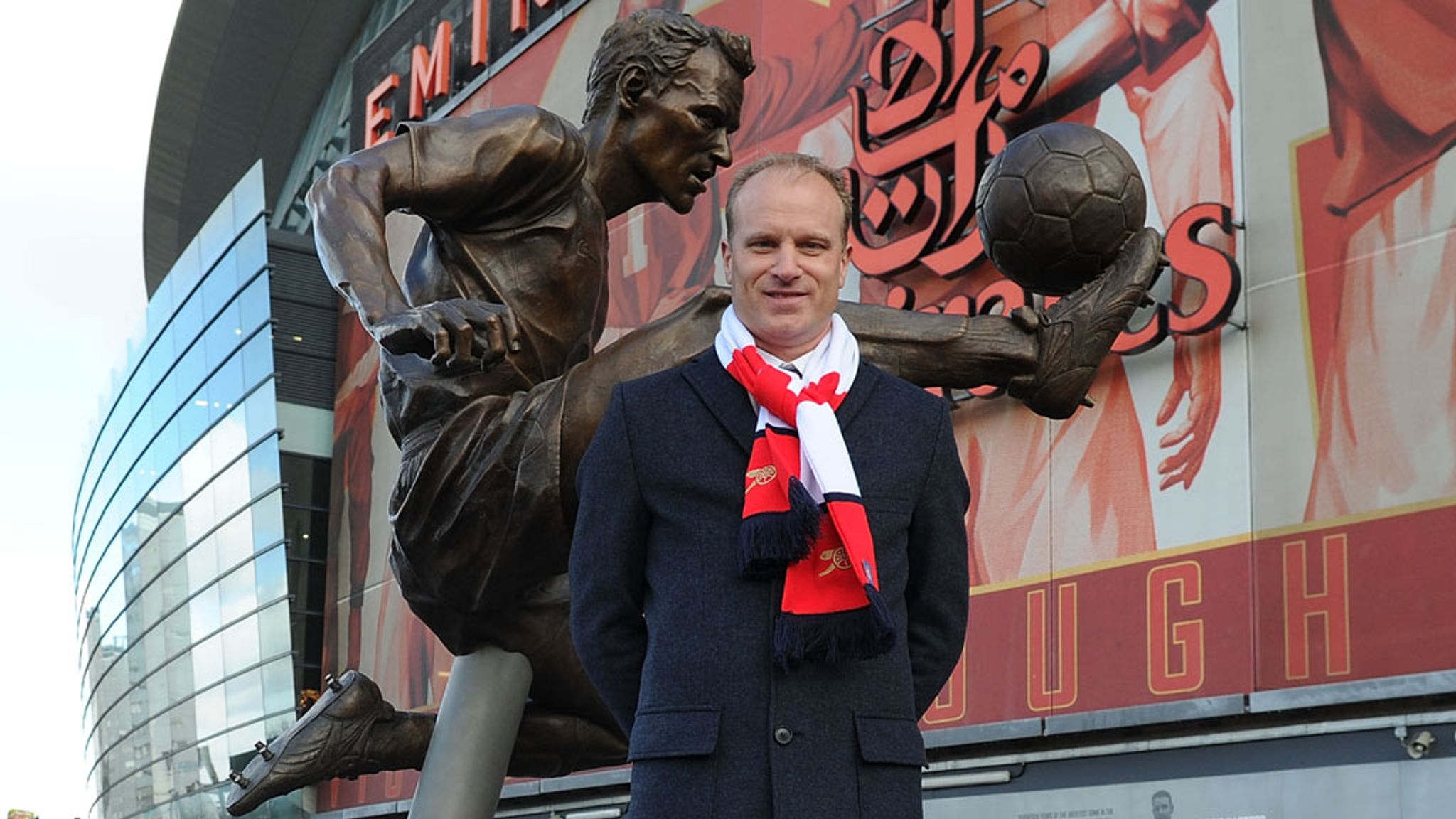
His statue now stands outside Emirates Stadium honouring him as one of Arsenal’s legends.
Dennis scored his 100th goal in an away FA Cup game against Oxford United on January 4th, 2003.











 Bergkampesque