
‘Stillness and Speed’, by Dennis Bergkamp – A Review.
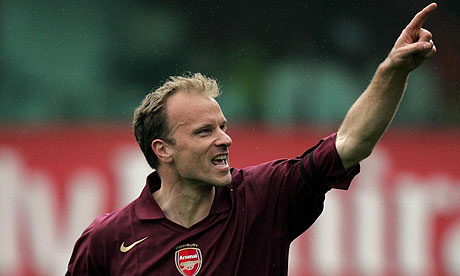
In terms of footballing autobiographies I am not very widely read; I think the extent of my involvement is Perry Groves’s (which was ridiculously funny in places, but amounted to essentially a collection of anecdotes) and Kenny Sansom’s, which I still haven’t finished. However, having spent four days immersed in Dennis Bergkamp’s experiences, I have emerged from my self-imposed exile from humanity with a much more satisfied glow than these other former Gunners provided, or threatened to provide. I feel now much more like I did at the end of Fever Pitch: pleased that God made me Gooner, and privileged to enjoy football in a way that only a Gooner can (and as Nick Hornby pointed out, this sometimes involves intense disappointment, frustration and hatred). If you’re looking for an objective review, you’re probably on the wrong website. I don’t want to ruin this book for anyone either, so my review won’t mention anything in great detail, as I could not do any of what was said justice by rehashing it into my own words.
Overall one of the best things I found was that the narrative isn’t a ghost writer imposing his own linguistic artistry onto Dennis’s thoughts and portraying them as his own, but rather a transcript of interviews with him and others who knew enough about him to add something worthwhile to the book (family, friends, colleagues and bosses from the teams he played for – notably Ian WWW, Thierry Henry and AW).
As I read the first few pages, I began to realise why I didn’t become a professional footballer (as I had wanted to when I was 6), or even very good at football at all: the attention to detail that Dennis put into everything, particularly football, was incomprehensible to me; and the feeling that he understood deeply something I only ever see superficially grew as the book progressed, as he spoke about distances between players, angles, manipulating space on the pitch, working for the team and making the perfect pass.
As an Arsenal fan, knowing where the book was headed even at the beginning, I was delighted to learn that he had put in more time and effort as a kid playing football on the street than I have ever had the concentration to put into football – he would aim for particular bricks in the wall he used to kick a ball against and constantly test out what happened when the ball rebounded in this way or that, or when he changed variable x, y or z.
Another impressive trait I observed was that of him not objecting to other people seeing events differently to him: he called it having their own truth, and he encouraged the authors to get the points of view honestly from others involved, such as at Inter Milan, where he doesn’t seem to have had a very good time. And although he would defend himself against some of what was said it would only be to put across his own view.
Turns out Dennis Bergkamp doesn’t like to do things the way other people do them.
That’s why he signed for Inter instead of Milan, opting against joining the Dutch trio who enjoyed enormous success there, where he would have been able to integrate pretty easily with van Basten and co, but would have become just another player scoring lots of goals: he wanted to make a distinct mark. It is also one of the reasons why, when he left Inter, he signed for us rather than the Spuds where Hoddle, one of his favourite players, had made a mark. Whatever the reason, and really the story of every human life hinges on decisions which may be made on little more than a whim, he signed for Arsenal and he has Arsenal in his blood now.
It was illuminating reading about situations at Highbury when Bruce Rioch was appointed; this was a time when the information superhighway was more of a dirt track, and one I was not connected to: most of my ‘knowledge’ of football came from Amiga games, and I was more concerned with whether Arsenal had beaten Villa or Man United than I was with who our manager was. From the time he was appointed to the time he departed, all I knew about him was that he’d been the Bolton manager when they’d knocked us out of the FA Cup. I didn’t realise he’d had a vision for Arsenal to play attractive football too.
Despite my comments about Perry Groves’s book earlier, autobiographies would be nothing without anecdotes, and once Dennis has signed for Arsenal there are a good few of them, and as a Gooner a lot of them made me giddy with excitement, as I’m sure they will you lot too.
I know I said I didn’t want to spoil it but if you don’t know the one about his first meeting with Ian Wright, you’re in for a treat; in general however it was exhilarating to see what other people at Arsenal had to say about him, particularly Thierry and Wrighty, who played up front alongside him. I get the impression that it was really at Arsenal he was allowed to become the footballer he wanted to be and his commitment to the team (whichever one he was playing for) is something that is reflected in the way he takes pleasure as much in his assists as he does in his goals.
It is lovely to relive his great goals as well though: another reminder as to why I was never going to play football for a living though as he talked me through his decision making processes and the attendant awareness of everything around him on the pitch. The goal against Newcastle still has me in awe, as does the one for Holland at the World Cup.
Discussions of his experiences at Ajax, Inter and Arsenal lend themselves naturally to delicious considerations of his footballing ideology both by himself and others, notably Johan Cruyff, AW and Thierry. Certain transfer decisions are cast into lights we may not have considered before too, which, whilst objectively uninteresting, is still of immense interest to (certain) Gooners. I was just annoyed Vieira to Juve wasn’t one of them.
I’m not a literature buff so I don’t read many books more than once, but this is certainly one I will come back to. Because of Stillness and Speed, my three-year-old can now recognise DB10 and AW, and I feel like a better informed Gooner for reading it.
I cannot recommend it highly enough, especially to Gooners.
Written by: Jozefos2013
For another review, see this Guardian link:
http://www.theguardian.com/football/2013/sep/21/dennis-bergkamp-arsenal-love-game
TA











 Bergkampesque