It’s all about the transition!
There has been recent commentary on a range of tactics and what makes us succeed or appear to be less successful. In particular, the area around defense and how we defend has arisen with strong sentiments around Arsenal “allowing” other teams to score or laying too far back.. In my opinion, no one is allowed to score, but the game is, in fact, a game, which implies both teams have a say in the outcome. Which is to say this isn’t La Liga with (nowadays) 3 teams beating up the rest who are of a clearly lesser level in many cases.
So, what is it about? What differentiates our successful periods from periods less dominant? Some say it is Flamini, no Flame, no game, might be the succinct response. Others imply we relax after scoring early and let others back in the game. Still more point at supposed weaker links, Arteta or Scz, or immobile Germans for defensive issues.
To me, in my analytical way, experience says two things:
1. There are two phases to the game – when you have the ball and when you don’t.
2. There are three often interchanging roles of each team in a game – on top, even handed, and behind the 8-ball, which is to say pressurizing and under pressure, with the middle being the arm wrestle tussle for control.
Equally, a physicist will tell you that if you expend excessive energy with the ball and pressurizing, you will, in a zero sum game, have to rest at some other time (and be pressurized). In contrast, a serious football fan will tell you to never give up the initiative. I will tell you that football is all about being able to count to 3 or 4, a game of numbers.
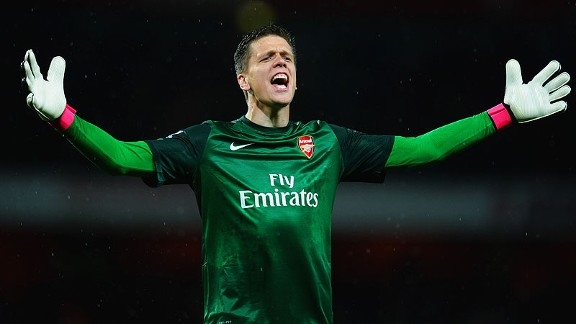
More succinctly, most goals come from gaining numerical advantage. Even JWs wonder goal #1 vs Norwich had local 2-1 advantage for every touch to break through 4 people (2-1 at a time).
Finally, however, it is a game and both sides play a role and try their best. Especially in the EPL, where the guaranteed wins have come fewer and harder every year of recent. Only Sunderland seem a sure bet right now and even that will possibly change before they are relegated (as seems likely at the moment).
So, what makes Arsenal right? And what is different when we are “wrong” or “off”? How do we maximise our numbers and minimise the opponents?

To me it’s all about the transition. Every team plays with and without the ball. The critical moments are what occur right after the ball changes hands and how one “finds numbers”.
For the moment let’s presume that we lose the ball and the other team (Whomever FC) do not immediately hoik it up field or turn it back (i.e. they aren’t Stoke and act rationally). What happens next or should happen next.
When we are going well: We race back and get in front of the ball which is critical to making sure the opposition do not get numbers. Hence, we all love fast counters because they give you numbers and we all groan when the ball goes sideways on a rapid Arsenal counter.
The entire goal is to get in front, with reasonable shape (2-3 layers) and, this is the key, aggressively front the ball. That aggressive first “fronting up” should push the ball sideways and slow the opposition transition.
The next key step is shape and aggressively moving forward, as a unit, so that the next pass goes back and then the next…
When we are successful, we bully teams back into their own end, even without the ball! When we are not they are allowed to play or move to easily.
Flamini gives us a lot of this “first fronting up” which allows players to get back, as well as the vocal organisation. If there was an argument “against” Arteta it is that he is perhaps too passive this way in comparison and a little too passive on the counter (when we are on offence). Not always but enough. Hence, Flamini’s importance, but, an importance that can be replicated.
The benchmark is Napoli, this year at least, and watch the game again at Arsenal.com and you will see that we never let them get a free forward pass with the ball, or barely so. Aggressively fronting through most of the game we bullied them time and again into passing all the way back to Reina. Not beautiful Wenger-ball perhaps but beautiful to watch and a sign of utter domination. Combined with incisive attack finding numbers and advantage versus an increasingly frustrated and confused opposition, and the outcome was certain.
When we are not going well: Well just the opposite, too passive and too slow to front the ball. The opposition gets better numbers or is allowed the opportunity to find them. Our slack period as we caught our breath was about this. We didn’t adapt tactics and effort to be more solid, and to me, it starts with someone getting in the face of the ball carrier. Without Flamini it was likely needing to be Cazorla (fatigued) and JW along with Arteta and Ramsey. If one is missing and the opposition comes through that area…
IMO, here is where JW is weak. He is aggressive as hell at coming back but doesn’t get in front preferring to come from behind or the side. As a result, he either gets the ball (good) or fails and doesn’t force the attack to slow, instead inadvertently actually pushing it forward (bad). It’s also where Rosicky is better or more experienced. Its not all JWs fault by any means but you defend as a team and if one or more elements aren’t in synch..
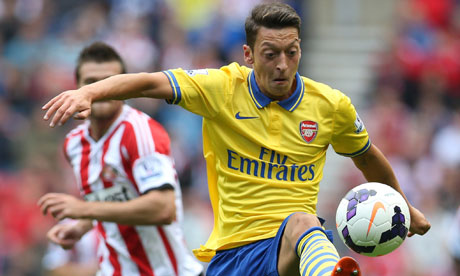
On attack you ask? Well the same holds in reverse really. When we go well we are incisive and forward. This is where Ozil has really helped us be more direct, and where, again if you want to see Arteta as a negative, he is perhaps a touch more cautious. Equally, JW at his best drives the game forward and finds numbers, TR the same, which is why they are always “visible” when going well on attack.
Equally, in this context, one could readily argue that JWs goal vs Norwich was Norwich allowing Arsenal to aggressively strike forward to find numbers 2-1 each time to remove a player in what was at the outside 3 vs 5. IMO, that’s unfair to Norwich and Arsenal as that was perfect aggressive play and not much stops that!
So, in summary, no one can dominate all of a game and all of the ball. There will always be times when we don’t have it and where after huge efforts on our part the other team is dominant. It’s how we respond and the basics we follow that, to me, determine the outcome.
In fact, I like it this way. It’s a game and if the other side has no chance what’s the fun? Better then to root for the underdog which is about all the fun there is to be had (again my opinion) in any Barca game that isn’t vs RM or Atletico. No games at all are like that in the EPL these days based on recent results that have helped put our team at the top of the table.
Finally, it is all about the players. If I examine our team now, I would say that Flamini is the glue that stops opposition transition the best and that makes a huge difference to half our game. Ozil, as is well discussed, adds the incisiveness we lacked last year as well as another SQ threat with Santi, and the super emergence of AR and OG this year. Questions, they come around Arteta adapting just a little in my opinion and JW, as he comes into form, finding the defensive half of his game gaining maturity. These will both come with time.
So, what do you think? Football is a very simple game with a at least a billion interpretations on how to play it best. Hopefully, this note at least fills the period between what I hope is a great, pressuring, perfectly transitioning domination of Dortmund and the weekend vs CrystalPalace!
To me it’s all about the balance defined by how we transition and thus whether we can dominate the ability and opportunities to find numbers and advantage or if we have to rely, as we did all too often in past on some magic from one or another player.
This year, I think we have the team to not to have to rely on magic too often … which is the first time since perhaps 2004ish and thus very good!! As long as we stay solid in the transition!
And a last question, if with way of looking at it in mind you could get any player in January who is it and why will they help us in transition?
Written by: JGC









 Bergkampesque